Concrete Pumping
From boom pumping to telebelts, we help concrete placement teams deliver best-in-class service with every job.


Roll-off operations
Updated November 2, 2026
Here is a story most growing roll-off owners will recognize. Picture an owner we will call Denise, who started her roll-off company with five trucks and a whiteboard. At 5:30 every morning she wrote the day's drops, swaps and pickups on it, called the drivers, and did the invoices herself after dinner. Two years on she runs 15 trucks, a full-time dispatcher and a billing admin, and the whiteboard is gone.
This Monday, her new dispatcher asked for his own login. The software vendor said that was fine: another seat, billed every month. By lunch Denise had a spreadsheet open, trying to work out whether a second dispatcher next spring was worth it once the extra logins were counted. If you have grown a yard, you have built that spreadsheet too. It is the right question, asked one seat at a time.
TLDR
The best dumpster rental software for 5 to 25 trucks is priced by the truck, not by the office login, and keeps outside haulers and shop work connected to the rest of the operation. CRO works this way, with unlimited office users on every plan. Before you sign with anyone, ask for a quote at 5, 15 and 25 trucks.
Seat fees are the cost you notice first, but they are rarely the one that hurts most. What gets expensive as a roll-off company grows is the second system: a separate tool for outside haulers, another for the shop, and the hours someone spends retyping between them. So we suggest judging software by what the whole stack will cost at 25 trucks, not by the sticker price at five.
At five trucks, software needs to do three jobs well: put the day's jobs in front of the drivers, show where every container is, and turn finished jobs into invoices. Almost everything else can wait.
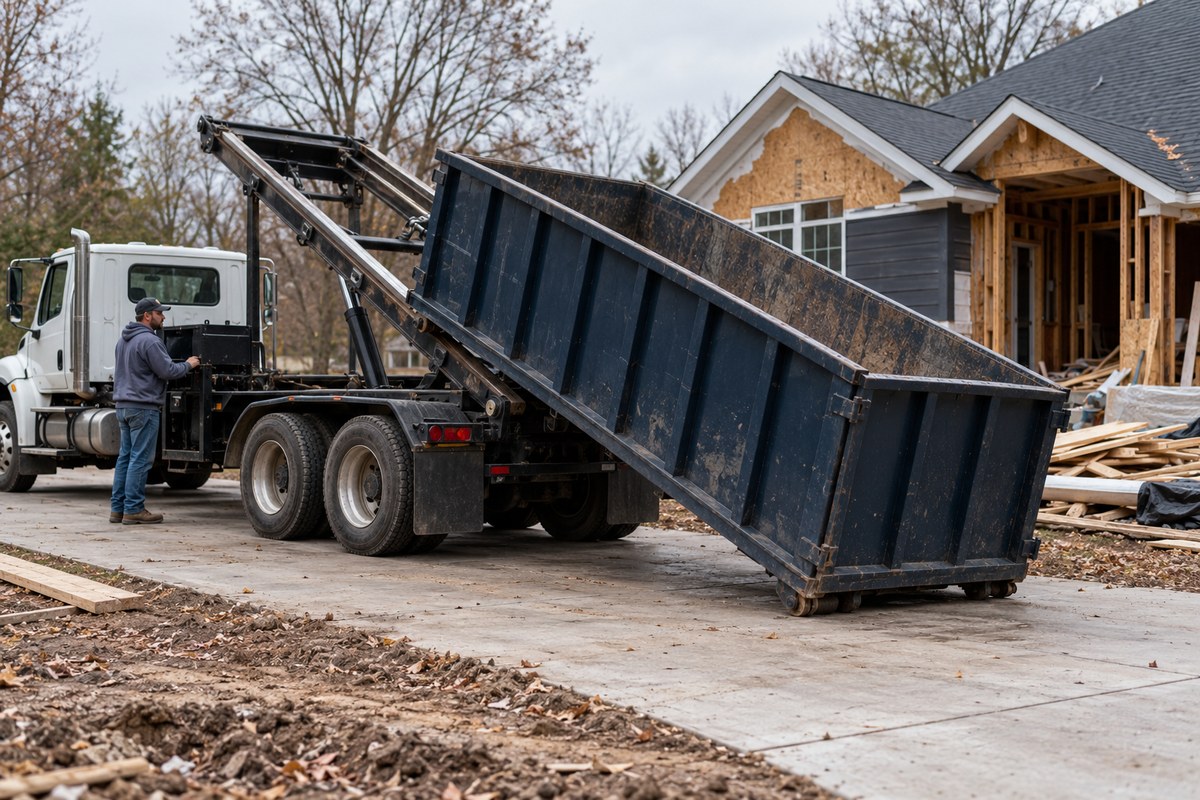
When Denise had five trucks, she was the dispatcher, the billing department and the person who answered the phone, so one office login covered the whole company.
This is also the stage where it is easiest to overbuy. A package with shop work orders, multi-branch reporting and a customer portal looks like good value on a demo, but if you have no shop and one office, you are paying for screens nobody opens. At five trucks with the owner dispatching, a lighter setup may do the job. A whiteboard or shared calendar for the schedule, plus QuickBooks Online for invoices, carries plenty of small yards through their first years. Do not buy shop software before you have a shop.
The lighter setup starts to strain in familiar ways: a container nobody can place, a swap that never made it onto an invoice, a spreadsheet that takes a minute to open because three people keep copies of it. Our guide to what breaks first when you start scaling a roll-off business walks through those break points. When they start showing up every week, the cost question changes from "what does software cost?" to "what will it cost when we are twice this size?"
At 15 trucks, the people in the office become the cost driver, because this is when most owners hire their first dispatcher and a billing admin. If your software is priced by the user, each hire raises the monthly bill. If it is priced by the truck, the bill moves only when the fleet does.
Seat pricing is common, and it is not unfair. QuickBooks Online, for example, ties its plans to user counts: as of November 1, 2026, Essentials includes 3 users, Plus includes 5 and Advanced includes 25. The catch for a roll-off office is that seats can tempt people to share one login, and a shared login means nobody can tell who changed the schedule at 6:10 a.m.
Here is the arithmetic Denise was really doing. Say a seat-priced tool charged $60 per office login a month. That is a round number for the example, not any vendor's price. With just Denise, that is $720 a year. With Denise, a dispatcher and a billing admin, it is $2,160. Now set that against the person: the May 2025 median annual wage for dispatchers was $50,340, according to the U.S. Bureau of Labor Statistics. The seat fee is real money, but it is small next to the salary.
A per-truck fee, by contrast, follows a cost you have already decided to carry. Under federal rules, a straight truck with a gross vehicle weight rating of 26,001 pounds or more is a commercial motor vehicle, so each heavy roll-off truck you add needs a driver with a commercial license. The May 2025 median wage was $28.19 an hour for heavy and tractor-trailer truck drivers and $23.89 an hour for refuse and recyclable material collectors. Next to a new driver, a software fee that rises by the truck is a small line that moves with revenue.
That comparison is useful because it puts the decision back where it belongs. Whether growth justifies a dedicated dispatcher is still the owner's call, made on call volume, swap counts and how many evenings you spend catching up. Software should not be the reason you delay that hire, and the seat line should not be the number that decides it.
At 25 trucks, the add-ons show up: outside haulers covering overflow, a shop with its own mechanic, and often a second dispatcher. Each one is a new problem, and the easy fix is a new tool for it. That is where the real cost of growth hides.
Take outside haulers first. On a busy week, Denise's yard sends overflow jobs to a partner fleet. If those jobs live in a text thread instead of the job record, the office loses sight of whether the container was dropped, where it went and whether the job is ready to bill. Our guide to keeping outside haulers in one job record covers how to hand those jobs off cleanly.
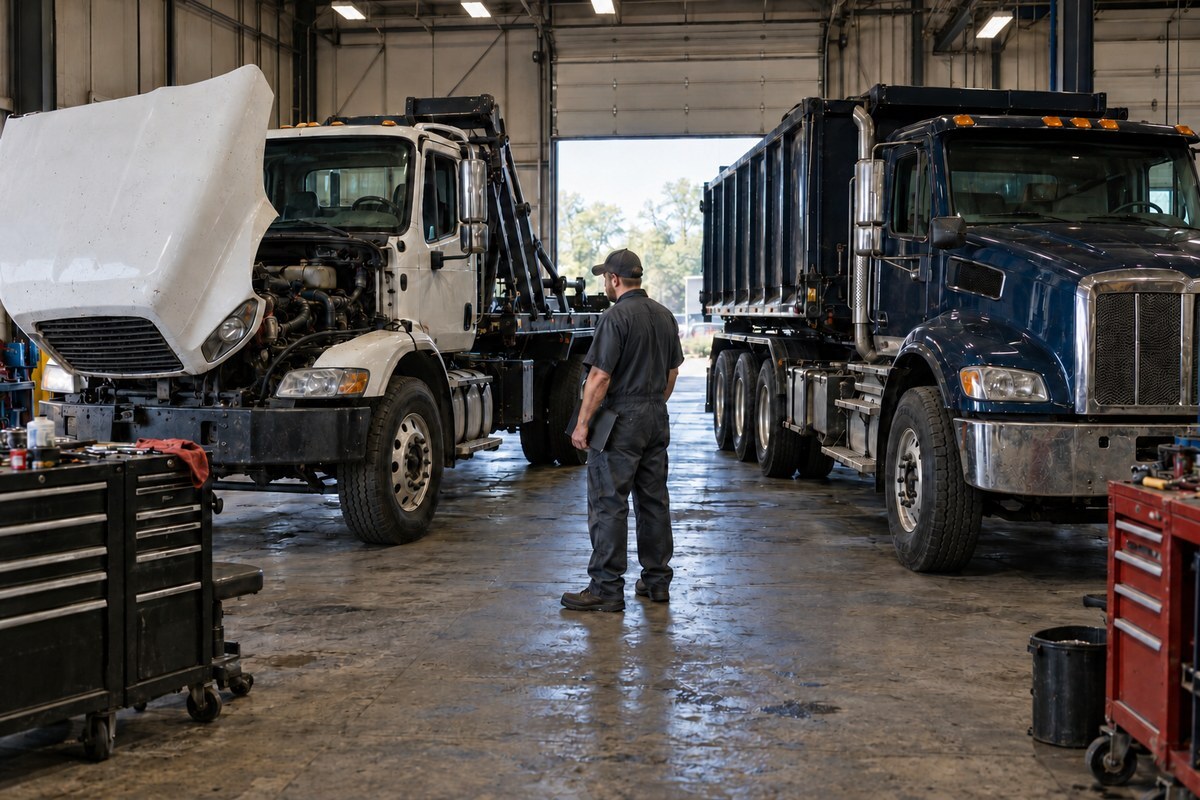
Then there is the shop. Federal motor carrier rules require covered carriers to systematically inspect, repair and maintain every vehicle they control, and to keep records for each one, including when each inspection and service is due. Those records are kept for a year, and for six months after a truck leaves the fleet. Drivers must report defects in writing at the end of the day, and each vehicle needs an inspection within the preceding 12 months. The rules also allow those records to be kept electronically. At five trucks, a folder can hold all that. At 25, the shop needs a system, and the question is whether it talks to dispatch.
This is where the second system costs more than any seat. Say your billing admin spends 20 minutes a day copying jobs from a separate hauler tool into billing, and the same again moving shop status into the dispatch schedule. At the May 2025 median wage for billing and posting clerks of $23.32 an hour, each 20-minute daily task over 250 working days is about 83 hours, or roughly $1,940 a year. Two of them come to about $3,890 a year, before either tool's subscription. The 20 minutes are assumptions for this example; put in your own.
The retyping also brings mistakes. In a review of the research on spreadsheet errors, Ray Panko found that errors are extremely difficult to detect and that the people who build spreadsheets are highly overconfident in their accuracy. Every copy between two systems is a chance for a missed swap or a truck booked while it is still on the lift. Our guide to scaling a roll-off business without losing containers or revenue covers the container side of that problem.
Add up the whole stack by writing one line per item and filling it in at three sizes: 5, 15 and 25 trucks. Count what each tool charges and how it charges, then add the time spent moving information between tools. The yearly total looks like this:
Yearly cost = 12 x (base fee + per-truck fee x trucks + per-seat fee x office users + each add-on's monthly fee) + one-time setup + hours spent retyping x the hourly wage of the person doing it
Here is the worksheet Denise filled in for her own yard. Her office users are just her at five trucks; her, a dispatcher and a billing admin at 15; and two or three more at 25. Fill in your own counts in place of hers.
| Item | 5 trucks | 15 trucks | 25 trucks |
|---|---|---|---|
| Trucks priced | 5 | 15 | 25 |
| Office users | 1 | 3 | 5 to 6 |
| Outside haulers | Rarely | Busy weeks | Weekly |
| Shop | Garage | Garage | In-house |
| Systems in sync | 1 | 1 or 2 | Up to 3 |
Then take the worksheet to every vendor and ask the same questions, so the quotes line up:
| Item | What to ask |
|---|---|
| Base and truck fees | What is the quote at 5, 15 and 25 trucks? |
| Office logins | Does adding a dispatcher or billing admin change the price? |
| Outside haulers | Can partner fleets work jobs inside your system, and at what cost? |
| Shop | Is maintenance in the same system, and how is it priced? |
| Setup and training | What is charged once, and what is charged again when we grow? |
We suggest filling it in this order, so the numbers you compare are the same shape:
CRO fits operators who want the bill to follow the fleet. We price CRO on a flat monthly base fee plus a per-truck fee, and every plan includes unlimited office users, so there are no per-user or per-seat fees. With CRO, a new dispatcher or billing admin does not raise the bill. We quote exact pricing on your truck count and setup, which is why the 5, 15 and 25 truck quotes are the right thing to ask us for.
The add-ons that appear at 25 trucks stay connected to the rest of the operation. Our Third Party Hauler App lets your office assign and track jobs for outside fleets, so work stays visible even when it goes out on someone else's truck. For the shop, Rapid Fleet Maintenance adds work orders, preventive maintenance plans with reminders, inspection checklists with mechanic sign-off and a compliance center for maintenance records. If you want it, ask us to include it in your 25-truck quote so the number covers the shop too.
That connection is what makes CRO reliable as you grow: dispatch, drivers and the back office work in one system, outside fleets' jobs stay visible, and maintenance stays connected instead of living on a whiteboard in the shop. More than 700 waste and site service companies trust CRO to run their operations. Hoffman Sanitation is one of them: it grew from 3,000 to 13,000 customers within its first few years on CRO, cut billing time by more than 90 percent (from five or six people working a full week to one person in about four hours), and now finishes daily billing in under 30 minutes. If you are still comparing tools, our ranking of roll off dumpster software and our buyer's test for a cloud-based roll-off platform cover the rest of the decision.
Before you sign, ask every vendor for three numbers: the yearly cost at 5 trucks, at 15 and at 25, with office users, outside haulers and the shop shown as separate lines. A vendor that is confident in its pricing should have no trouble putting all three in writing.
Picture Denise doing exactly that. She fills in the worksheet on a Tuesday night, sends it to three vendors, and stops arguing with herself about logins. The quote that changes least between 15 and 25 trucks is the one worth a closer look, because it already counts the second dispatcher, the overflow fleet and the mechanic she has not hired yet. The second-dispatcher decision goes back to where it belongs: her call volume.
If you are at five trucks and still dispatching from the whiteboard, keep the lighter setup a while longer and keep the worksheet handy. Ask for the three quotes when the break points start showing up. Either way, the number to trust is the one at 25 trucks.
Bring your worksheet and see what CRO costs at 5, 15 and 25 trucks, with unlimited office users on every plan.
Not always. A one-truck owner with one office login may pay less on a per-user plan. Per-truck pricing pays off when the office grows, as it does when you hire a dispatcher and a billing admin. Compare quotes at your expected size, not today's.
Ask each vendor directly, because the answer changes the math. Pricing models differ on whether a driver's app login counts as a user. Write each answer on the worksheet so every quote counts drivers the same way.
Usually when the shop moves in-house. Federal motor carrier rules require covered carriers to keep inspection, repair and maintenance records for each vehicle, and those records are easy to keep in a folder at five trucks and hard at 25. Before then, an outside garage's records may be enough.
It depends on how clean your customer, container and pricing data is, and on how many people need training. Ask each vendor for a written setup plan with dates, and plan the switch for your slowest month rather than the start of busy season.