Concrete Pumping
From boom pumping to telebelts, we help concrete placement teams deliver best-in-class service with every job.


Roll-off operations
Updated October 27, 2026
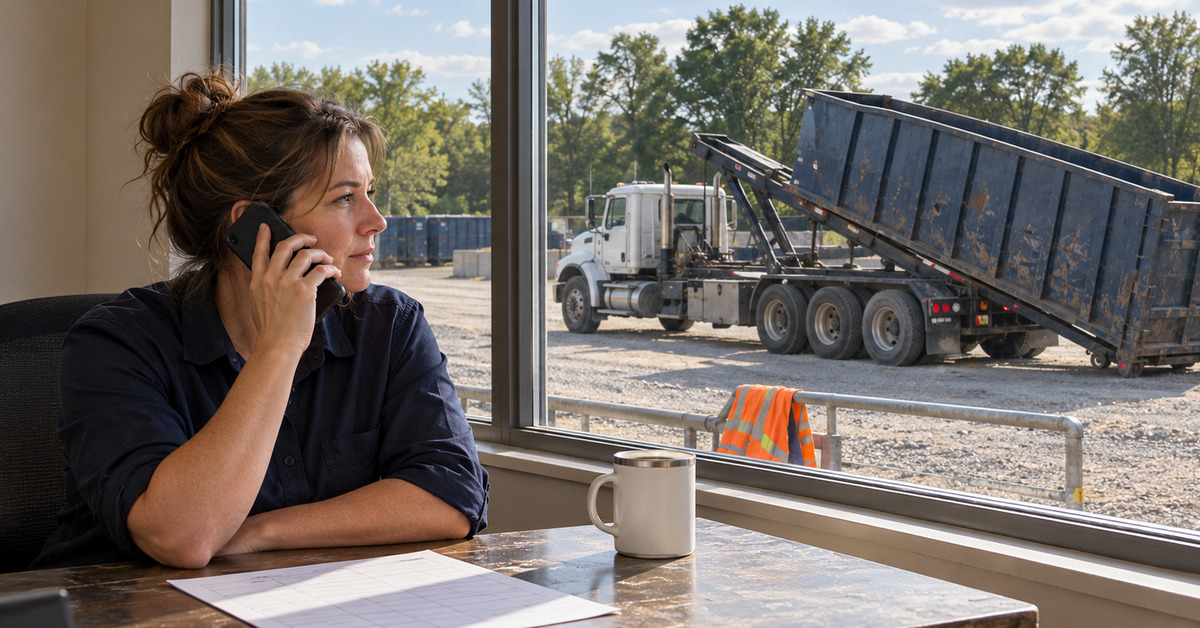
Here is a Tuesday afternoon most roll-off offices know by heart. Take Carla, who runs the office for a nine-truck roll-off company. The afternoon schedule lives in a spreadsheet on her desktop and on the whiteboard behind her chair, and by 1:30 every driver has left the yard with his stops.
The first change comes at 1:40. A remodeling contractor leaves a voicemail: his three-person crew filled their 30-yard faster than planned, and they need a swap by 2:30 or they stop work. Carla hears it at 2:20, between other calls, and rings Luis, who is driving and cannot pick up. He calls back at 2:35 from a stop on the far side of town, doubles back about 14 miles, roughly 35 minutes of driving, and finishes the swap at 3:30.
The second change comes at 2:05. The owner, Rick, is walking a new build across town when the builder asks for a 20-yard at a second lot before four. Rick says yes and means to call the office. He texts Carla at 2:30 instead, between other conversations, and she finds the text under six others at 3:10. The 20-yard arrives at 4:40. Everybody did their job. The changes just had to travel by phone and text to reach a schedule that only one desk could see.
TLDR
A good cloud-based roll-off dumpster rental management platform like CRO puts the office, the owner and every driver on one live schedule, so a change made anywhere reaches the right truck without a phone call. Judge it by how fast a change shows up in the driver's app, not by where the server sits.
Cloud is an easy word to put on a product page. The question that matters for a roll-off business is narrower: when a change is made at 2 p.m. on a job site, is it on the driver's screen before he pulls away from his next stop? If it is, the platform is doing its job. If somebody still has to call him, the schedule may be in the cloud, but the business is still running on the phone.
A good cloud-based roll-off platform connects the office schedule with driver job updates, so nobody has to carry a change from one person to the next.
The formal definition points the same way. The U.S. National Institute of Standards and Technology lists broad network access as one of the five essential characteristics of cloud computing: capabilities are available over the network and reached through standard mechanisms from mobile phones, tablets, laptops and workstations alike. For a roll-off company, that means the dispatcher's desktop, the owner's laptop on a job site and the driver's phone are all windows onto the same jobs, not three copies of them.
That rules out a few setups that sound like cloud but behave like the desktop in Carla's office:
Both changes got stuck in the same place: between the person who heard about them and the one schedule that could put them on a truck. Neither the contractor nor Rick could touch Carla's spreadsheet, so each change waited for a person to carry it.
| Change | How it reached the office | When a driver knew | What happened |
|---|---|---|---|
| Early swap on a full 30-yard, requested at 1:40 | Voicemail, heard at 2:20 between other calls | 2:35, when Luis called back from a stop | The crew waited; the swap was done at 3:30 |
| New 20-yard delivery, agreed at 2:05 | The owner's text at 2:30, read at 3:10 | 3:20, once Carla found a free truck | Delivered at 4:40, after the builder's deadline |
Look at the 15 minutes between Carla's call and Luis's callback. That gap is not carelessness. A driver behind the wheel of a loaded truck should not pick up, and federal rules for commercial motor vehicle drivers prohibit both texting and using a hand-held phone while driving, including while stopped in traffic or at a light. So every change sent by call or text waits for the driver's next stop anyway. What decides the afternoon is whether, at that stop, the change is already in front of him or still sitting in someone's voicemail.
The office pays its own price. Carla spent the afternoon answering the phone, checking the whiteboard and calling drivers back on top of her regular work, and research on interrupted work by Gloria Mark and colleagues found that people make up for interruptions by working faster, with more stress and frustration. Anyone who has run a dispatch desk on a busy afternoon knows the feeling, and so does the spreadsheet that has been open since 7 a.m. and is now slowing to a crawl.
One afternoon like Carla's costs real money, and most of it never shows up on a report. Luis's 35 minutes of doubling back, at the May 2025 median wage for heavy and tractor-trailer truck drivers of $28.19 an hour (U.S. Bureau of Labor Statistics), comes to $16.44. His 14 extra miles, at the 8.1 miles per gallon the Federal Highway Administration reports for single-unit trucks in 2024 and $6.276 a gallon, the U.S. average diesel price for the week of October 19, 2026, burn about $10.85 of fuel. Say Carla lost 25 minutes to calls and callbacks: at the May 2025 median dispatcher wage of $24.20 an hour, that is $10.08.
That is about $37 for one afternoon, or roughly $3,890 a year if it happens twice a week. It leaves out the contractor's side: his three-person crew stood around for an hour, which at the May 2025 median wage for construction laborers, $22.66 an hour, cost him about $68, and that is the kind of afternoon that makes a customer try someone else. Put in your own delay and weekly frequency.
Test a cloud platform by making a change and watching where it goes. We suggest three tests you can run in any demo, with your own busiest afternoon in mind:
If you are still building a shortlist, our ranking of the best roll-off dumpster software compares the main platforms. If you want a longer script with a late pickup, a reoptimized route and a disposal cost change, our late-change workflow test walks through four changes step by step.
With CRO, the office, the owner and the drivers work from one live schedule: the office in a web browser, drivers in the iOS or Android app. CRO is trusted by more than 700 waste and site service companies, which manage over 11 million jobs a year with it, and the first two tests map to things the platform does every day.
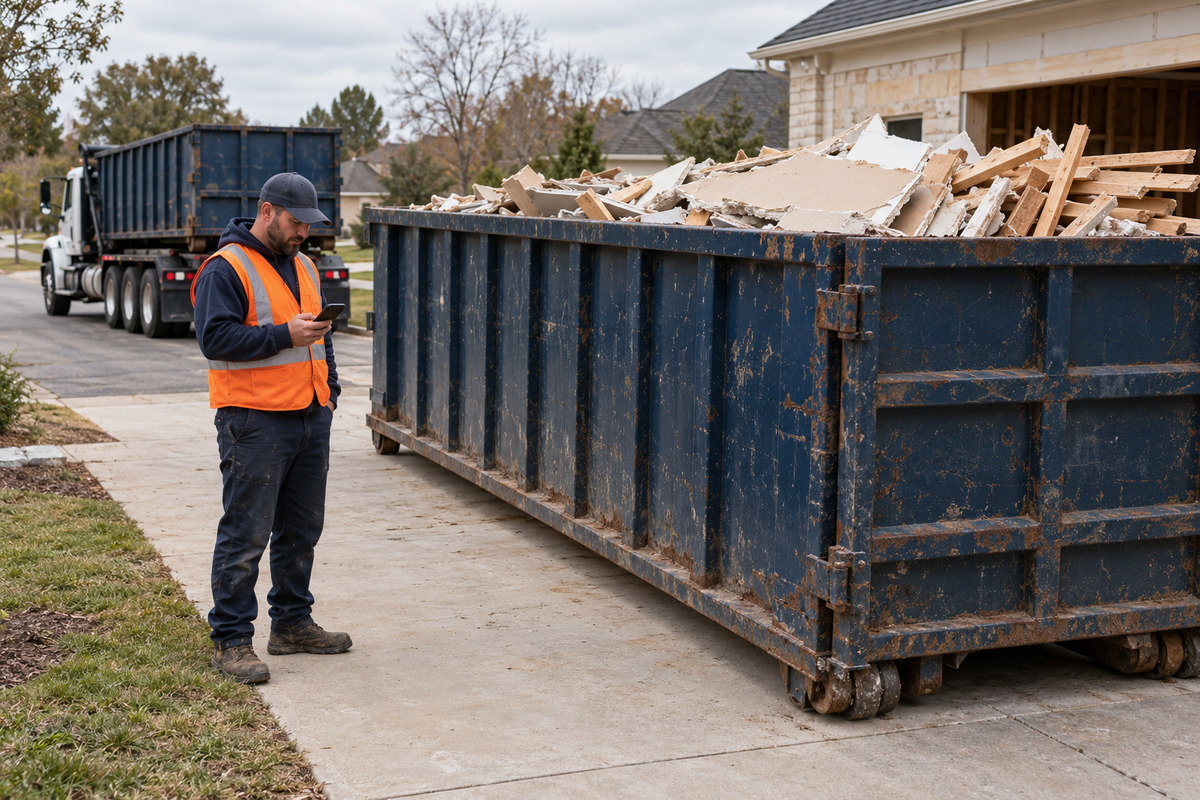
On Carla's Tuesday, the contractor would have submitted his 1:40 swap request through the portal, and Carla would review and dispatch it. She could see that Luis had just finished the stop before, two miles away, so she would drag the swap onto his truck, and he would have it in front of him when he opened the app before pulling out. At 2:05, Rick could log in from a browser at the job site and add the 20-yard order himself while the builder was still talking. That is what makes the setup reliable: the order Rick enters on the job site appears on Carla's board, ready to dispatch to Luis, with no retyping in between.
The decision about which truck takes the swap still belongs to Carla. CRO lets her review customer requests and assign work to drivers, but she is the one who knows Luis's truck is empty and the other driver is on his way to the landfill. For the third test, ask in your demo, as you would anywhere, how you would see who moved a job and when. If your next question is how dispatch, driver tracking and billing fit together, our guide to running them from one waste operations platform covers it, and our piece on why container visibility breaks down across yards, jobs and dispatch covers the container side.
A cloud schedule fixes the trip a change takes from one person to another. It does not fix everything, and three limits are worth knowing before you choose:
Picture Carla's next Tuesday on one live schedule, with the same two changes. The contractor's swap request comes through the portal at 1:50; she puts it on the closest truck, the driver sees it at his next stop, and the swap is done by 2:25. Rick adds the 20-yard from the job site at 2:10, and it is on the ground by 3:30. Carla makes two calls all afternoon, and both are to customers.
Nothing about her job changes except where the changes land. Before your next demo, try this: write down every change from your busiest afternoon last week, who heard about it first, and when the driver found out. Then bring that list along and run the three tests against it.
Want to watch a swap request reach a driver's app without a single phone call?
One that connects the office schedule with driver job updates. A change made by a customer, the owner on a job site or the dispatcher should reach the right driver's app without a phone call, and the job should keep a record of what changed.
For most companies with more than one or two trucks, yes, because the person who hears about a change is often not at the office computer. Software on one computer makes every change wait for someone to carry it there. A one-truck owner who takes every call may not need it yet.
The office works on a dispatch board in a browser and drivers use a mobile app that reads the same jobs. When a dispatcher moves a job onto a truck, it appears in that driver's app, and the driver updates the office from the app instead of calling in.
Run three tests: check that the office and the driver app show the same job, time how long a moved job takes to reach the driver without a phone call, and ask how you would see who changed a job and what the driver recorded at the stop.
A cloud schedule reaches a driver's phone when the phone has a data connection. Check your service area for weak coverage before you rely on app updates alone, and agree with drivers how changes reach them on those stops.