

Concrete Pumping
From boom pumping to telebelts, we help concrete placement teams deliver best-in-class service with every job.
/TEST%20icons/noun-concrete-pump-5976240.svg)
/Industry%20Icons/noun-5917380.svg)
/Industry%20Icons/noun-truck-4140346.png?width=60&name=noun-truck-4140346.png)


/TEST%20icons/noun-crane-truck-6830557.svg)
/TEST%20icons/noun-drilling-5103943.svg)


/Industry%20Icons/noun-road-fence-3990160.png?width=60&name=noun-road-fence-3990160.png)

/No%20Background/noun-maintenance-7409171-F1612C.png?width=60&name=noun-maintenance-7409171-F1612C.png)


Updated 2 October 2026
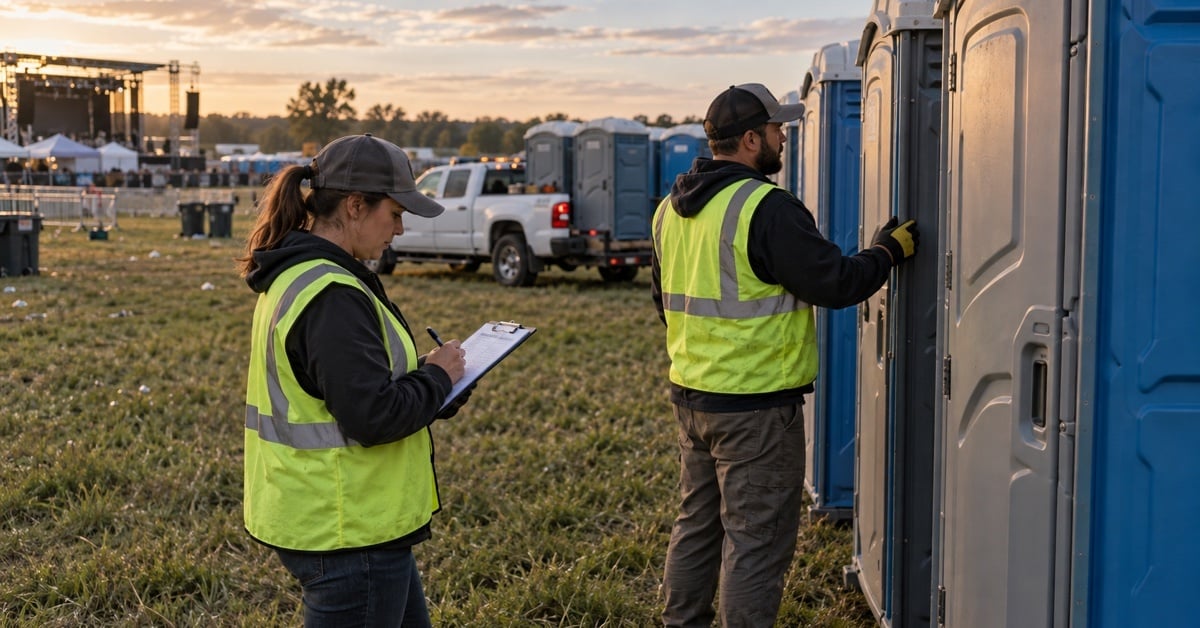
Quick answer: Close out a portable toilet event in two passes. First, reconcile each unit's physical outcome: back at the yard, verified elsewhere, verified at the placement awaiting pickup, or unresolved. Second, record condition separately, then let an operator decide to hold or release the unit. These are fields to test, not a claim about automatic CRO status labels.
The event may be over for the customer while asset reconciliation is still open for your team. A reliable closeout makes that distinction visible. Dispatch should be able to see which units are accounted for, which need another movement, and which require an operator decision before they return to available inventory.
A unit can be back at the yard and still need cleaning. It can be damaged but fully accounted for. It can also be sitting at a verified off-site location without being lost. Those are different operational facts, so track them separately.
| Field to reconcile | Example outcome | Next decision |
|---|---|---|
| Physical location and pickup | Back: verified at the yard or designated return point. | Inspect before deciding on cleaning, repair, or release. |
| Physical location and pickup | Moved: verified at a different location. | Accept the new location, schedule another movement, or assign a pickup. |
| Physical location and pickup | Still in place: verified at the planned placement, awaiting pickup. | Keep the unit accounted for and assign the remaining pickup. |
| Physical location and pickup | Unreconciled: there is not enough evidence to confirm the unit's location or pickup outcome. | Assign an owner, next action, and deadline. |
| Condition | Cleaning, damage, or inspection hold: a separate condition flag, never a location. | Inspect or repair before any release decision. |
| Release decision | Held or released: the operator's decision after the required checks. | Return only released units to available inventory. |
This structure prevents a common counting error: treating damage as though it were a fourth location. First reconcile where every unit is. Then apply cleaning, damage, and release decisions to those reconciled units.
OSHA's own sanitation standard requires a toilet facility to be kept sanitary, stocked with hand-cleaning supplies and available when needed, not merely present on the lot. That is a separate bar from location, which is another reason a condition flag has to travel on its own instead of riding along with a location update.
A closeout record does double duty. Philadelphia's Office of Special Events requires a special event permit review once an event uses more than 15 portable restroom units, and Santa Barbara's parks department planning guide sets a ratio as tight as one unit for every 250 to 300 attendees, depending on the event. An 80-unit event already sits inside that kind of permit bracket in most cities, so the same reconciliation that closes your event can double as the record a venue or permit office expects to see.
If part of the site is a construction footprint for the event build, such as a staging or backstage area, it can sit under a different compliance floor. OSHA's construction sanitation standard requires at least one toilet facility to remain available under temporary field conditions, a separate requirement from the event's own attendee ratio, so do not assume clearing the event permit count also clears that bar.
Some of those units carry a second obligation. The U.S. Access Board's ADA guidance on portable toilet rooms calls for at least 5 percent of the units in a cluster to be wheelchair accessible. Your closeout roster should flag which units are the accessible ones, because losing track of an accessible unit is a different problem than losing track of a standard one, and a location field alone will not tell you which is which.
The Portable Sanitation Association International trains operators on the same three-part job a closeout depends on: deciding the right number and type of units for an event, choosing a placement configuration, and following specific behaviors when placing, servicing, and picking up special-event units. Build the closeout record around those same three inputs.
Start with the event's expected unit roster rather than reconstructing it after the trucks return. Each record should identify the unit, its planned placement, its most recently verified location, and the work needed to close it.
In CRO, you can manage static and dynamic routes, unit location plots, driver photos and signatures, service completion, and event workflows. Use those records as closeout inputs, while keeping the final exception and release decisions with the operator.
At minimum, prepare these fields:
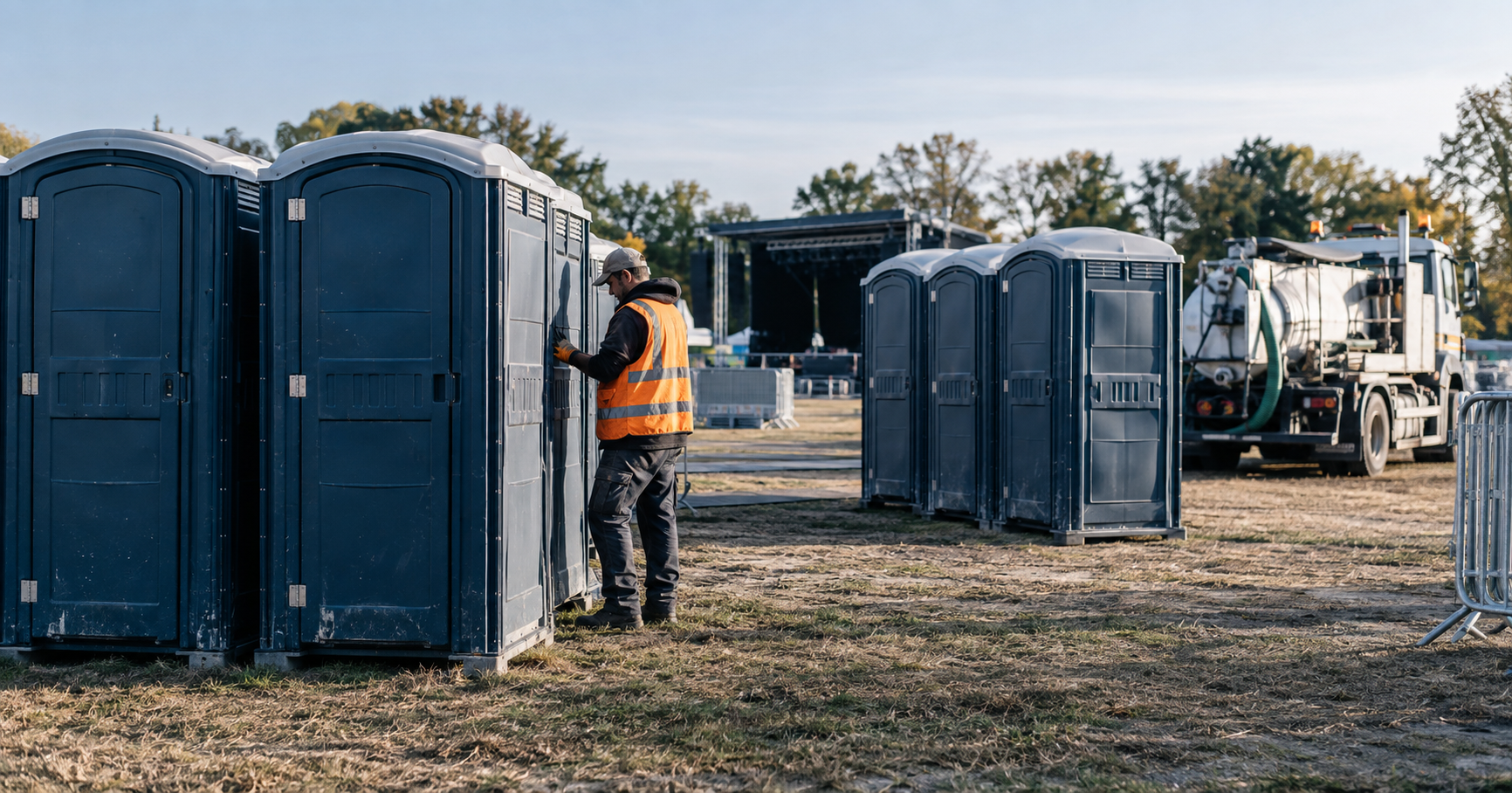
An unresolved unit should not disappear inside a general event note. Put it in a short decision queue that tells the next operator exactly what is known and what must happen next.
Keep the queue operational. “Investigate” is not enough. “Dispatcher to confirm the north service gate with the venue by 10 a.m.” gives the team an owner, an action, and a deadline.
Trade coverage of inventory practice in the portable sanitation industry backs the same point. A Portable Restroom Operator preseason inventory article (16 April 2026) states that tracking which units were deployed, serviced, and returned is what protects accurate billing and prevents asset loss, not the total placed at delivery.
A completed stop, photo, or signature helps establish what happened in the field. It should not, by itself, return a unit to available inventory. The release gate belongs after the unit has been reconciled and any required cleaning, condition, or damage checks are complete.
That boundary matters most when the next rental is close. Releasing units from a route total can hide an unresolved move, a cleaning hold, or a damaged unit that happens to be back at the yard.
OSHA's own test for treating a portable toilet as an acceptable sanitary facility asks whether it is readily accessible, adequately lit, secure, and properly serviced (OSHA standard interpretation, 18 May 1999), the same checks a condition flag exists to capture. A completed pickup stop tells you the unit was there. It does not tell you the unit still passes that test.
Consider a hypothetical 80-unit event. The closeout finds 74 units at the yard, three in a verified venue storage area, two still at their planned placements, and one without a trusted final location. The roster balances to 80 as 79 physically reconciled units plus one unresolved unit. The event is not fully reconciled because one unit remains unresolved.
Put a number on that one unresolved unit using national benchmark rates, not a RapidWorks price. Fixr's portable toilet cost guide (rate table updated 31 January 2025) lists a standard unit's weekly rental at $150 to $300, about $220 at the midpoint, and a new unit's replacement cost at $700 to $3,000. If the unresolved unit stays open for one more week before it turns up or is written off, that is roughly $220 of disputed billing on top of whatever the customer is asking to void. If it is genuinely gone, the exposure runs from $700 to $3,000 depending on the unit's age and features. Those are two different numbers, and only a resolved reconciliation tells you which one applies.
Damage and cleaning are then recorded as separate condition flags. Four of the 74 returned units may need inspection, for example, without changing the physical reconciliation. The operator can release the clear units, hold the flagged units, schedule the two remaining pickups, and assign the unresolved unit to a named owner.
In CRO, we built mapped unit placement, service history, and driver-verified proof for exactly this kind of unit-by-unit reconciliation. We can already show you where a unit was last verified, whether it moved, and what your driver photographed or captured a signature for at the last touch. That is the office-side evidence layer of a closeout.
We do not make the release call for you. Cleaning, damage assessment, and the decision to release a unit for another rental stay with your team, the same way dump-site exceptions and other field judgment calls stay with your drivers and dispatchers. Treat our records as the input to that decision, not the decision itself.
If your event runs two or three units from a single vendor, a phone call and a paper pickup sheet are still the right tool. The register itself is not the risk at that scale. Mapped placement and driver proof earn their place once a roster runs into dozens of units across more than one crew, which is where a paper count built after the trucks return usually breaks first.
For the asset-tracking habits that prevent this exact gap between events, see 5 Steps to Stop Losing Portable Toilet Assets and Run a Tighter Operation. For a standing account whose unit count changes between service visits rather than at one event's end, see How to Manage Recurring Portable Toilet Service When Units Move or Counts Change.
To see whether this fits your next closeout, bring one real event: a planned placement, a moved unit, a pickup exception, a damage hold, and a release decision. Walk every unit from the plan to the final decision and judge whether the record would have caught what a total count would have missed.
The event is fully closed when every planned unit has a verified physical outcome, every exception has been resolved, and the required cleaning, damage, and release decisions have been recorded.
No. If its new location is verified, record it as moved and decide whether to accept that location, transfer it, or schedule another pickup. Reserve unreconciled status for a unit whose final outcome is not yet supported.
No. Damage is a condition flag. A damaged unit may be back at the yard, at another verified location, or still unreconciled. Keeping condition separate from location preserves an accurate count.
No. A pickup photo is evidence for reconciliation. Release should follow the required cleaning, condition, and damage checks plus operator sign-off.