

Concrete Pumping
From boom pumping to telebelts, we help concrete placement teams deliver best-in-class service with every job.
/TEST%20icons/noun-concrete-pump-5976240.svg)
/Industry%20Icons/noun-5917380.svg)
/Industry%20Icons/noun-truck-4140346.png?width=60&name=noun-truck-4140346.png)


/TEST%20icons/noun-crane-truck-6830557.svg)
/TEST%20icons/noun-drilling-5103943.svg)


/Industry%20Icons/noun-road-fence-3990160.png?width=60&name=noun-road-fence-3990160.png)

/No%20Background/noun-maintenance-7409171-F1612C.png?width=60&name=noun-maintenance-7409171-F1612C.png)


Roll-off operations
Updated 9 October 2026
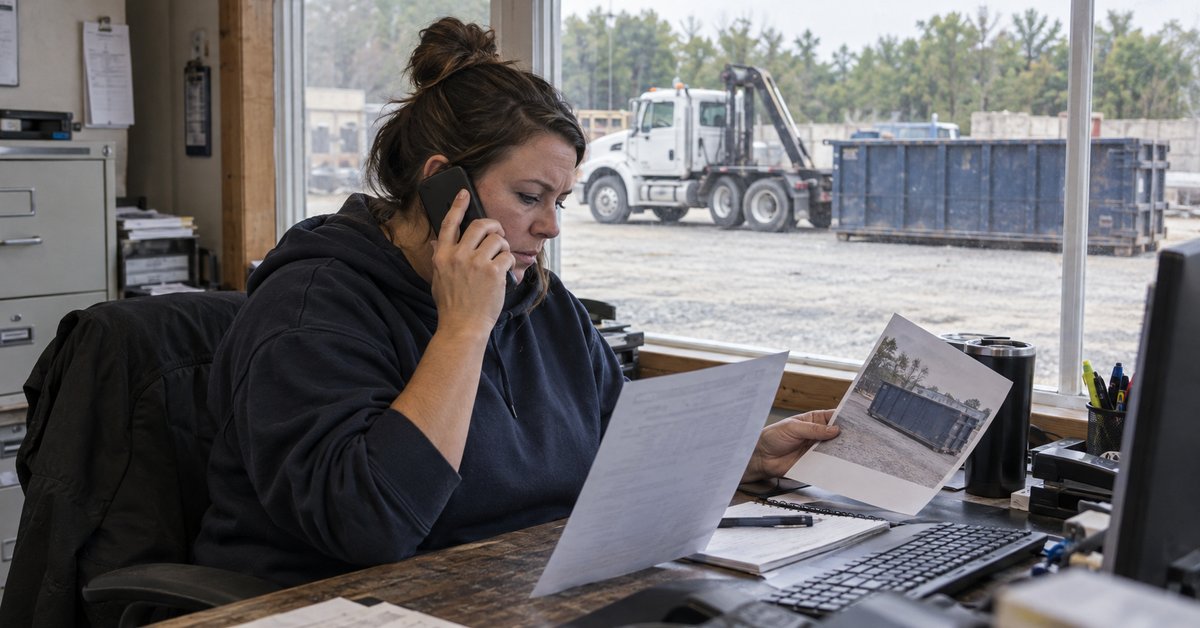
The phone rings at 2:40 on a Tuesday. A customer is on the line, certain of one thing: the swap never happened. The old container is still sitting there, she says, and the new one never showed up. Every roll-off dispatcher has taken a version of this call. The story always has two sides, and only one of them is on the phone.
The useful move is not to argue the story. It is to stop talking and start reading. Before the call ends, or before you call back, the job record already holds most of the answer. The rest is a judgment call that belongs to the office, not the app.
Pull the job record before you argue the phone call. Read the driver's timestamp, photo, and signature against what the customer described, then call back with the specific detail rather than a general assurance. A photo settles the facts of the job; deciding how to resolve the complaint still needs a person.
The same disagreement shows up as a wrong bin left in the wrong spot, or a dry-run charge a customer says never happened at all. Today it is the swap, and it is on the phone right now, waiting on dispatch to say something more useful than "let me check."
The customer's account and the office's paperwork disagree, and that has to be settled before anyone can hang up with a straight answer. Dispatch does not argue the story back. Dispatch puts her on a brief hold, pulls the job record for this exact container and this exact date, and reads it before saying another word.
With the hold music running, gather the pieces that let dispatch describe this job, not just confirm it happened:
That list takes two or three minutes to assemble once the job record is the single place all of it lives. It takes a lot longer when half of it is a text to the driver and the other half is a sticky note on someone's desk.
CRO gives dispatchers a driver app that requires a reason and a photo before a failed job can close, then lets the office reschedule the job, reassign it, or charge the dry run without losing what happened in the field. On a job the driver marks complete, CRO attaches that same driver's photos, notes, and the customer's signature to the job record. If the driver adds an overage or any other extra charge at the stop, that line carries straight to the invoice instead of becoming a note someone has to remember to add later.
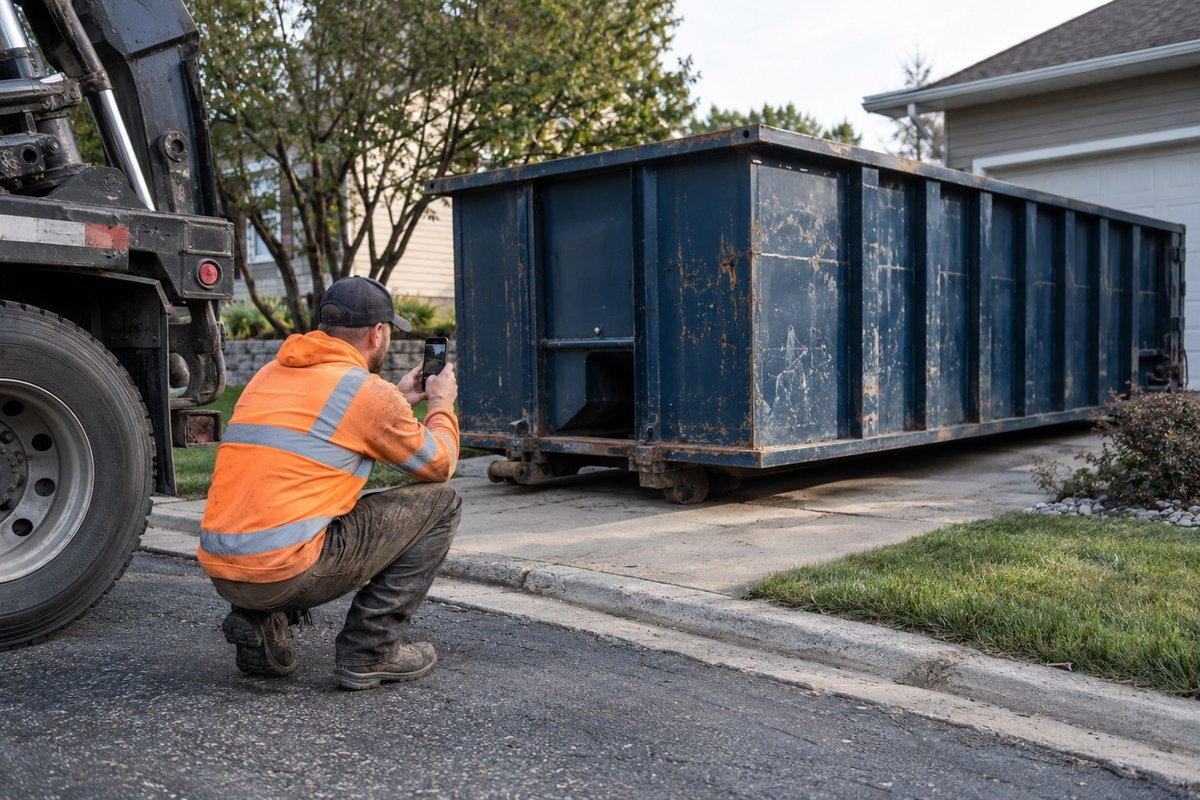
Pulled up on screen, this job record shows a completed swap: a timestamp at 9:14 that morning, a photo of a new 20-yard container at the curb, and no signature line filled in because the driver let himself through an open gate. That is what dispatch now has to line up against a caller who insists nothing arrived. Does the timestamp fall inside the window she was given? Does the photo show her curb, not a similar one from an earlier stop on the same street? Is there a reason the signature line is blank?

The timestamp and the photo do not settle this by themselves. Someone who knows the property still has to confirm that curb is hers, not the neighboring unit the driver visited an hour earlier on the same route. A blank signature line proves only that nobody met the driver at the gate; it does not by itself prove the right container landed in the right spot.
Deciding how to resolve this call, whether to describe the photo back to her, send someone to re-confirm the site, or adjust the invoice if the record turns out wrong, is a judgment call for whoever is holding the phone. The record narrows the disagreement to one checkable fact. It does not replace the person who has to decide what that fact means for this customer.
This is how that Tuesday call actually goes once the record is open, worked in order rather than improvised:
This is not a rule unique to waste hauling. Every system built to settle a disagreement between two accounts of the same event favors the record made at the time over the account given afterward. Under the federal business-records exception to the hearsay rule, a record made at or near the time of an event by someone with direct knowledge of it carries weight that a recollection, formed later and under pressure, does not.
Consumer and payment-dispute processes run on the same logic. The FTC advises keeping receipts and copies of supporting documents when challenging a charge, and its separate guidance on a bill for a service never received tells a consumer to keep records of the order, the dates, and every communication with the company. The Consumer Financial Protection Bureau asks a complainant to attach documents that support the facts, and its guidance on card disputes is just as direct: include copies of receipts, checks, or other proof of the transaction with the written notice. On the merchant side, Visa asks a business fighting a chargeback to gather receipts, shipping records, and customer communications to make its case. A Better Business Bureau complaint gives a business ten calendar days to respond, with the exact original complaint attached, not a summary.
Insurance claims run the same way for a different kind of loss. Guidance from state insurance regulators tells a homeowner to photograph damage and list losses before cleanup, because that record, not a description given afterward, is what an adjuster uses to settle the claim. A roll-off dispute runs on the same principle at a smaller scale: the photo taken at the stop is worth more than either side's memory of the stop a day later.
Assume a dispatcher spends 20 minutes on a disputed job call when the proof is scattered: checking a paper ticket, calling the driver, then calling the customer back a second time. With the photo, timestamp, and signature already attached to one job record, the same call takes roughly 6 minutes: pull the record, read the proof, call back once. That is a 14-minute reduction per disputed call.
At the median hourly wage for dispatchers of $22.53 (U.S. Bureau of Labor Statistics, Occupational Employment and Wage Statistics, May 2023), 14 minutes is worth about $5.26. An operator fielding six disputed calls a week saves roughly $31.50 that week, or about $1,640 across a year, before counting a single charge that gets corrected faster or a customer who does not have to call a second time. The call count, minutes per call, and dispatcher wage are assumptions for this example; substitute your own volume and wage to size the effect for your operation.
That is also before a dispute escalates past a phone call entirely. A disputed invoice that ends up in California small claims court carries a filing fee of $30 to $100 and typically gets a trial date in one to two months, time and cost that a documented resolution on the first call avoids altogether.
CRO's part in a dispute call is narrow and specific: it keeps the driver's photo, timestamp, signature, and any field-logged charge attached to one job record, so dispatch is reading one source instead of reconstructing the job from a text thread and a memory of the schedule. That is the record this article asks you to pull before you call back.
It is not a substitute for the two sibling questions this one leaves aside. If the question is which records to keep on every job, not just a disputed one, see 7 Proof-of-Service Records Waste Haulers Need in 2026. If the dispute involves a subcontracted hauler rather than an in-house driver, the handoff itself needs its own record before a dispute even starts: see Roll-Off Handoffs: Keep Outside Haulers in One Job Record.
CRO does not decide the dispute. It does not judge whether a photo shows the right container, and it does not pick the resolution. That stays an office call every time. What it changes is how long that call takes and how much of it is spent searching instead of deciding.
Back on that Tuesday call, the record settled it in under five minutes. The dispatcher read the photo back to her, curb and container and all, and she recognized the spot as soon as she heard it described: the new bin was there, just set further back from the street than the old one had been. The call ended with her thanking the dispatcher, not threatening a chargeback, and the job record now carries a one-line note explaining why nothing changed on the invoice.
Want to see how fast your own dispatchers could pull a disputed job record?
Pull the original job ticket, the driver's timestamp, the photo if the job required one, the customer's signature if the job required one, any overage the driver logged, the driver's site notes, and whether the account has a prior dispute on file.
A photo is strong evidence, not an automatic verdict. Someone who knows the site still needs to confirm it shows the right container in the right spot before the office decides how to resolve the complaint.
A dry run requires a reason and a photo before it can be charged, rescheduled, or reassigned. A completed job ties the driver's photo, notes, and the customer's signature to the job record. The proof that matters differs by which one is being disputed.
Treat the mismatch as a real exception, not proof that the customer is wrong. Recheck the site, the container, and the date before deciding, and document whatever you find either way.
When it is heading toward a credit-card chargeback or small claims court. Resolving it from the job record on the first call is almost always faster and cheaper than letting it escalate that far.