

Concrete Pumping
From boom pumping to telebelts, we help concrete placement teams deliver best-in-class service with every job.
/TEST%20icons/noun-concrete-pump-5976240.svg)
/Industry%20Icons/noun-5917380.svg)
/Industry%20Icons/noun-truck-4140346.png?width=60&name=noun-truck-4140346.png)


/TEST%20icons/noun-crane-truck-6830557.svg)
/TEST%20icons/noun-drilling-5103943.svg)


/Industry%20Icons/noun-road-fence-3990160.png?width=60&name=noun-road-fence-3990160.png)

/No%20Background/noun-maintenance-7409171-F1612C.png?width=60&name=noun-maintenance-7409171-F1612C.png)


Updated October 9, 2026
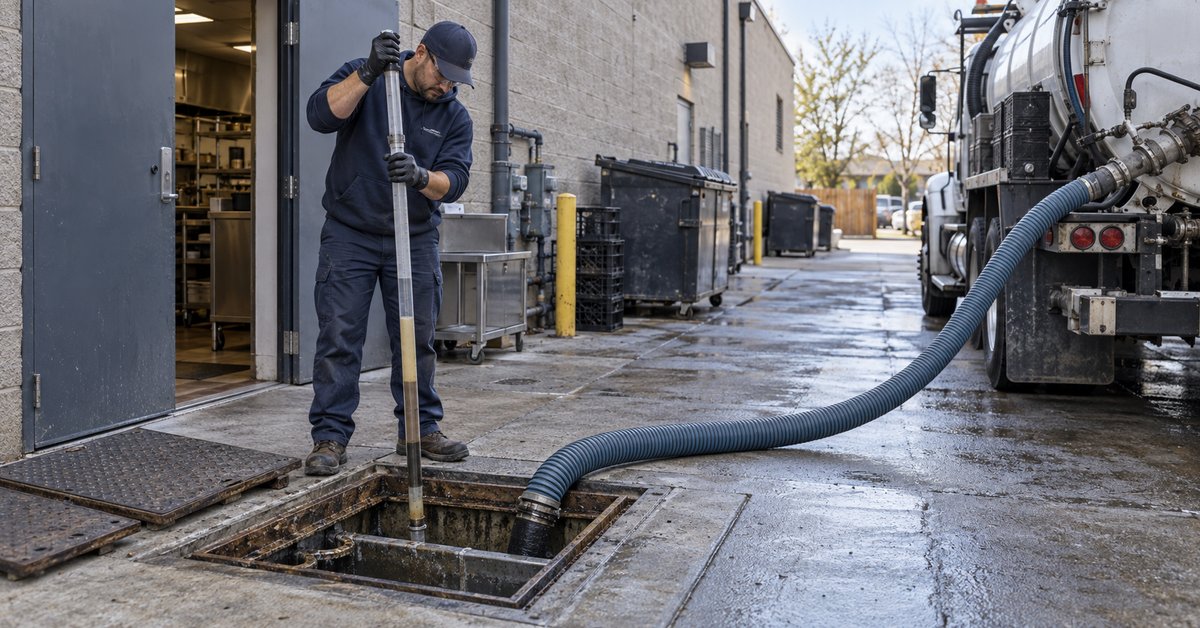
A 90-seat diner's grease trap sits off the back hallway, due for pumping by the calendar and about to get checked against its own history before anyone lifts the lid.
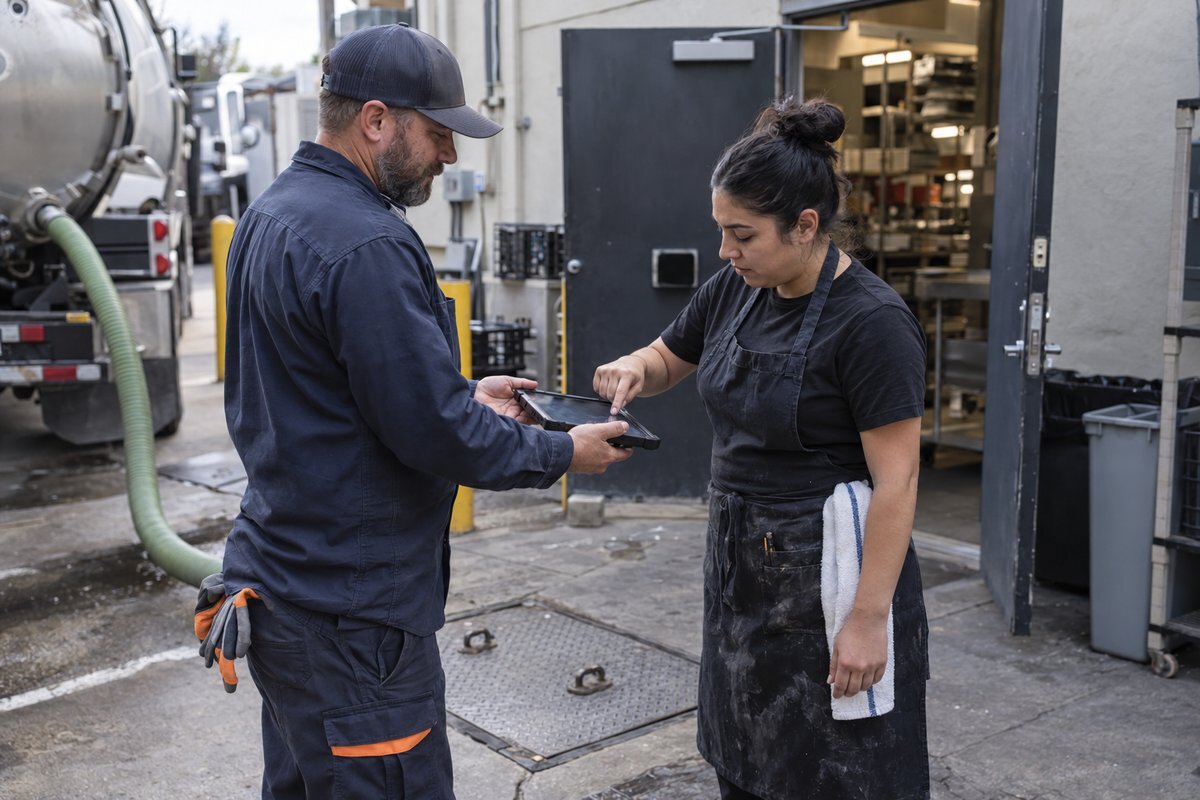
A grease trap service record is audit-ready when it carries five fields: the service date, gallons pumped, the trap's condition at open and close, the disposal destination and a signed proof of service. A municipal FOG program will ask for some version of that list; the exact format is the city's to set.
Deciding which traps need closer attention is a separate question. It comes from comparing gallons and condition across visits for that specific trap, a read that stays with the operator, not an automatic score.
This diner pumps every eight weeks, and the stop is already on the route before the lunch rush ends. The visit looks simple from the curb. What makes the resulting record defensible happens in five moves, in order.
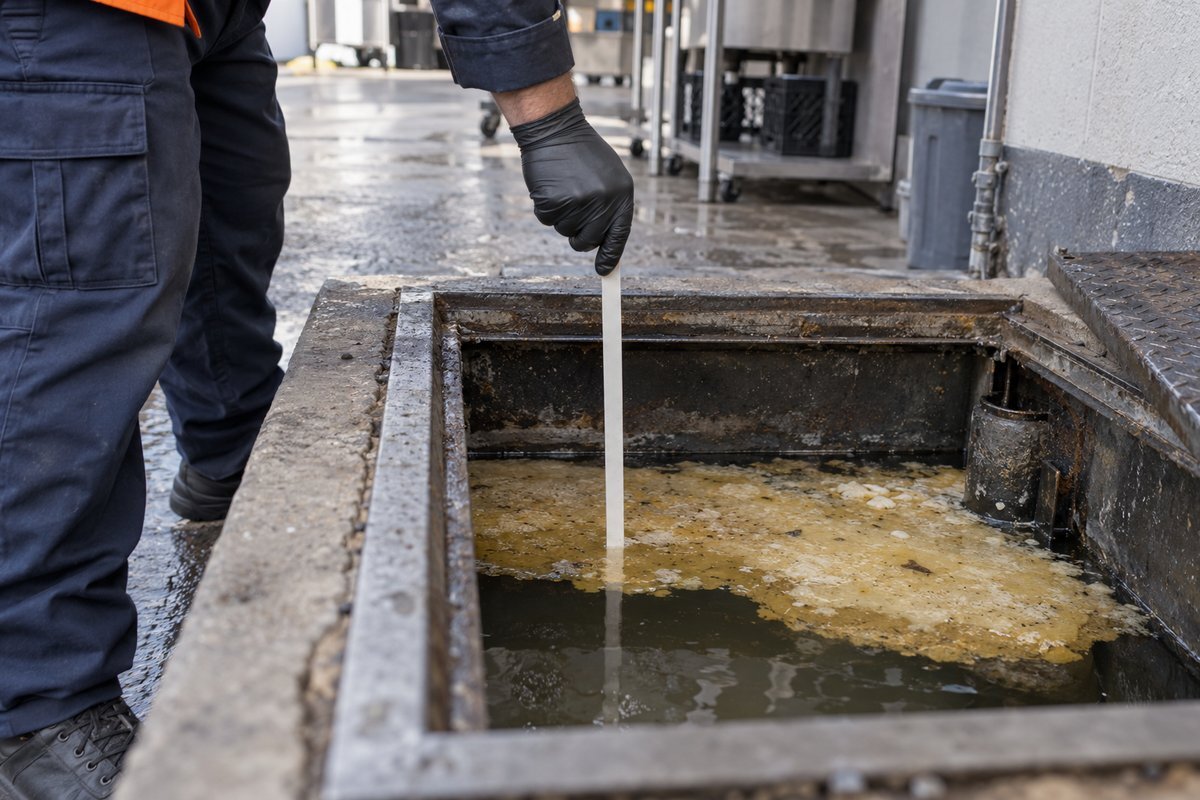
Strip the visit down to what has to survive on paper or in an app, and a closed grease trap job record needs five fields, regardless of which city's form it eventually feeds:
CRO gives operators FOG compliance reporting and grease trap performance tracking built on exactly these fields, so the same visit record that satisfies a restaurant customer's question is the one an operator hands to a municipal FOG program.
A calendar interval is a starting point, not the answer. The better read comes from comparing a specific trap's gallons and condition across its last several visits, the same history pulled at step one of the walkthrough above.
A trap that keeps showing up high and greasy before its scheduled window is up is telling the operator something a flat 30, 60 or 90-day interval will not catch on its own. A trap that consistently comes in low for its size may be a candidate to stretch, inside whatever minimum a city's FOG program sets.
This stays an operator call. CRO tracks the gallons and condition that make the comparison possible, but it does not score a trap or flag it as due for more frequent service; the read is the operator's, built from that trap's own record.
Every local FOG program sits on the same federal floor. The EPA's National Pretreatment Program is "a cooperative effort of federal, state, and local environmental regulatory agencies" built to "protect POTW infrastructure" and reduce pollutants reaching municipal sewer systems, with individual control authorities setting their own local limits underneath it. Within that framework, 40 CFR 403.5(b)(3) prohibits "solid or viscous pollutants in amounts which will cause obstruction" in a sewer system, and the EPA traces a large share of sewer blockages directly to restaurant grease. From there, enforcement is local: "more and more POTWs are addressing FOG discharges by imposing mandatory measures of assorted kinds, including inspections, periodic grease pumping, stiff penalties, and even criminal citations for violators," in the EPA's own description of current practice.
The stakes are real money. New York City currently sets its maximum penalty for a grease-interceptor violation at $10,000 per day, per violation, and routinely sends inspectors to check that interceptors are sized, installed and maintained correctly.
There is no single FOG report format every operator can fill in once and reuse everywhere. Three Minnesota cities alone show how much the form itself differs, and Texas, Connecticut and California each add a different layer on top.
| Program | What the record has to show | How long to keep it |
|---|---|---|
| Rochester, Minnesota | Date, name of the person or company cleaning the interceptor, certified hauler number, total liquid depth, grease depth, solids depth, percent full, destination of waste and an owner or manager sign-off | 3 years on site |
| West St Paul, Minnesota | Date of cleaning, who cleaned it, gallons removed and the disposal method | 2 years; emailed to the city every 3 months |
| Red Wing, Minnesota | Date, activity, name, total liquid depth, grease and solids depth, percent full, destination of waste removed and maintenance comments | 3 years on site |
| Austin, Texas | A liquid-waste hauler's manifest after every pump-out, plus the hauler's City of Austin permit number; traps must be pumped at least every 90 days or sooner once grease and solids reach 50% of wetted height | 3 years on site |
| Connecticut (state general permit) | Inspection date, inspector's name, title and signature, and the measured depth of grease and food waste; operating depth occupied by grease and solids must stay under 25% of total depth | 5 years on site |
| California (state hauler manifest) | Generator name and address, transporter name, driver name and signature, gallons or pounds collected and delivered, receiving facility name and a numbered tracking entry | 2 years, held by both the transporter and the receiving facility |
A visit record built from gallons pumped, trap condition, disposal destination and a signed proof of service covers the fields every one of those programs actually asks for. Which form it goes on, how long the city wants it kept and whether a hauler needs a separate permit number stays a local question, worth confirming with the specific city or county before the first report is due.
CRO gives operators FOG compliance reporting and grease trap performance tracking, gallon and capacity tracking for pump trucks, and a driver app where the selected disposal destination ties to the job record automatically, with photos and notes attached on-site. That turns the five-field record above into something the office can pull up for a restaurant customer's question or a municipal FOG request without rebuilding it from a paper ticket.
Two things stay outside that record and outside CRO. The exact format a specific city's FOG program wants, whether that is Rochester's depth-and-percent-full log or Austin's hauler manifest, is a local requirement an operator confirms directly with that city. And deciding which traps need a shorter interval is the operator's own read of a trap's gallon and condition history, not an automated flag inside the record.
For the fields a non-grease job record needs from pump-out to invoice, see how to track septic and liquid waste jobs from pump-out to invoice. For how dispatch decides whether a truck should unload before its next stop, see when a pump truck should unload before its next job.
Bring us one real grease trap stop, gallons, condition notes and all, and we'll walk through how it closes out as a record ready for a restaurant customer or a municipal FOG request.
A complete record carries five fields: the service date, gallons pumped, the trap's condition at open and close, the disposal destination and a signed proof of service. Match those five to whatever log, portal or paper form the city or the customer's insurer actually uses.
Compare the gallons and condition logged at a trap's last several visits. A trap that keeps coming in high and greasy before the service window is up needs a shorter interval. CRO does not flag or score this automatically; it is the operator's own read of that trap's history.
No. Cities set their own reporting format, and they differ, as the examples from Minnesota, Texas, Connecticut and California show. CRO gives operators the gallons, disposal destination, photos and notes a visit record needs; building those into the specific form a city or customer requires stays the operator's job.
The standard is a signed proof of service tied to the specific trap serviced, usually a customer or site signature captured on the visit along with timestamped photos and notes.
It depends on the jurisdiction: Austin, Texas, and Red Wing and Rochester, Minnesota, require three years on site; West St Paul, Minnesota, requires two; Connecticut requires five for its grease-interceptor general permit. Keep records at least as long as the strictest requirement that applies to that trap.