

Concrete Pumping
From boom pumping to telebelts, we help concrete placement teams deliver best-in-class service with every job.
/TEST%20icons/noun-concrete-pump-5976240.svg)
/Industry%20Icons/noun-5917380.svg)
/Industry%20Icons/noun-truck-4140346.png?width=60&name=noun-truck-4140346.png)


/TEST%20icons/noun-crane-truck-6830557.svg)
/TEST%20icons/noun-drilling-5103943.svg)


/Industry%20Icons/noun-road-fence-3990160.png?width=60&name=noun-road-fence-3990160.png)

/No%20Background/noun-maintenance-7409171-F1612C.png?width=60&name=noun-maintenance-7409171-F1612C.png)


Quick answer
Both CRO and ServiceCore run portable sanitation routes, dispatch, and billing, so the right pick depends on how many service lines you run. If your business is portable sanitation only, or portable sanitation plus septic, both platforms cover the core workflow. If you also run roll-off, solid waste, or scrap and metal recycling alongside portable toilets, CRO is built to run all of it in one system with unlimited office users and no per-user fees. ServiceCore's own site describes its scope as portable toilet, septic, and dumpster businesses, a narrower service-line footprint than CRO's five. Full comparison table below.
We looked for a dispatch board built around stops, service windows, and day-of changes rather than a generic job calendar.
We looked for whether individual portable toilet units can be tracked by placement and service history across multiple job sites, not just tracked as a truck route.
We looked for a mobile app crews use in the field for stop lists, service records, photos, and completion, feeding straight into billing.
We looked for a clean QuickBooks connection and billing that handles recurring service intervals, delivery and pickup fees, and event work.
We looked at which service lines each platform is built to run beyond portable sanitation, since many operators add a second line within a few years.
We looked at how the pricing model changes as trucks and office staff are added, and whether office growth carries its own charge.
| Capability |  CRO CRO |  ServiceCore ServiceCore |
|---|---|---|
| Portable sanitation route dispatch | Yes | Yes |
| Driver app with photo and signature capture | Yes | Yes |
| QuickBooks Online and Desktop sync | Yes | QBO focus |
| Customer portal for online scheduling | Yes | Yes |
| Roll-off container tracking in the same system | Yes | Yes |
| Scrap and metal recycling support | Yes | Not listed |
| No charge for additional office staff | Yes | Yes |
Best for
Operators who want portable sanitation, roll-off, septic, solid waste, or scrap and metal recycling in one connected system
Pricing
Flat base platform fee plus per-truck pricing, unlimited office users
Rank 1
What it is. CRO is a multi-service operations platform from RapidWorks, the leading software platform for heavy equipment and site service companies. It runs portable sanitation with additional support for roll-off, septic, solid waste, and scrap and metal recycling in the same account.
Where it wins.
Where to look closely. CRO is built as a full operations platform, so a route sheet that only needs basic scheduling for a single portable sanitation route will have more setup on day one than a narrower point tool.
The verdict. If service-line reach and one connected system matter more than a narrow, single-purpose tool, CRO is the stronger long-term fit.
Best for
Operators running portable toilet, septic, or dumpster service only
Pricing
Per-truck pricing; ServiceCore's own site states no charge for office staff
Rank 2
What it is. ServiceCore describes itself on its own site as software for portable toilet, septic, and dumpster businesses, covering route dispatch, inventory tracking, and billing automation for those three service lines.
Where it wins.
Where to look closely. ServiceCore's own homepage describes its scope as portable toilet, septic, and dumpster businesses. It does not list solid waste hauling or scrap and metal recycling among its stated service lines, so an operator adding either would need a separate system for that line.
The verdict. A strong option if portable sanitation, septic, and dumpster rental are the full scope of the business and are expected to stay that way.
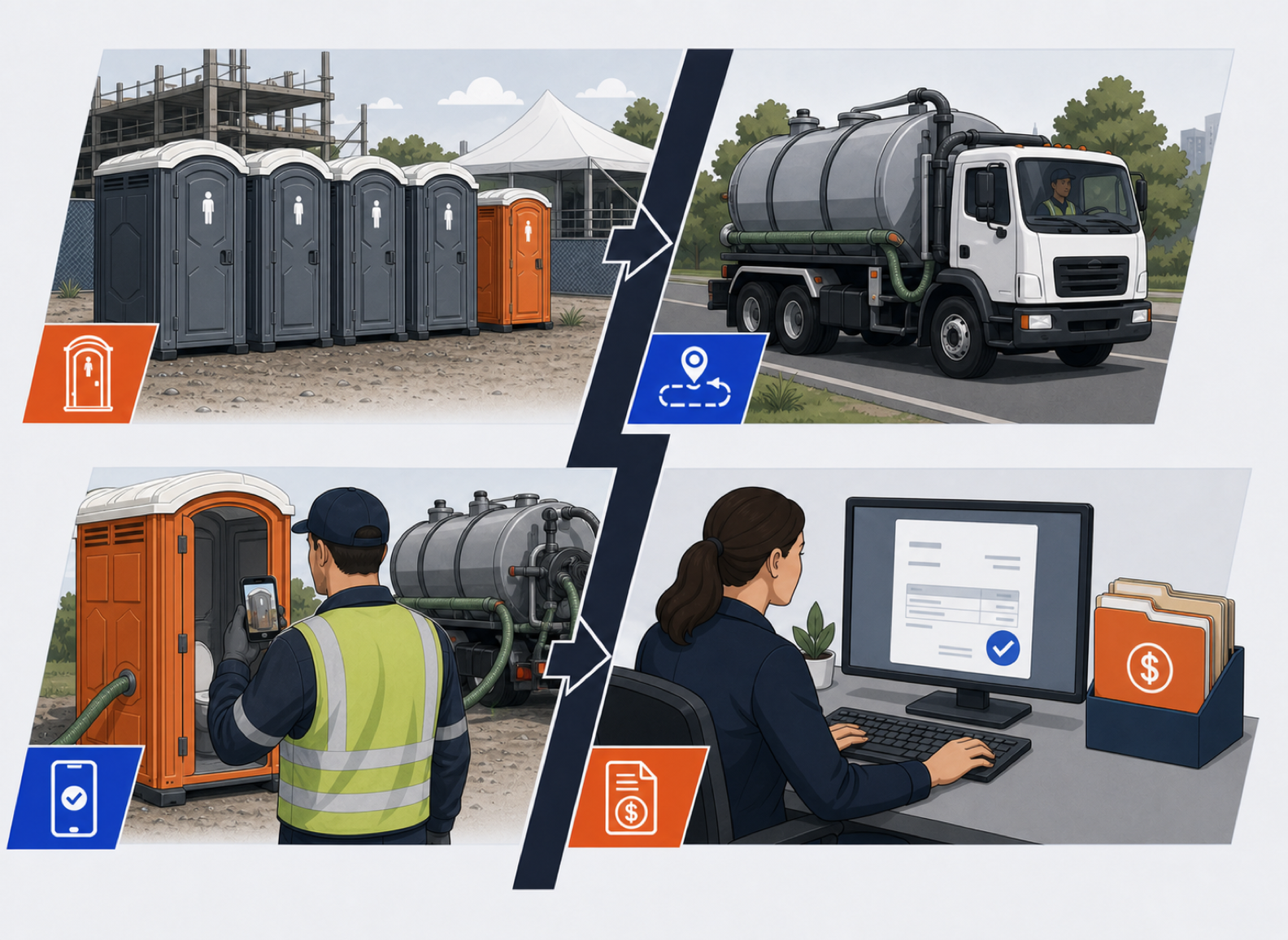
Most portable sanitation operators do not start out planning to add a second service line. It usually happens because a customer asks for roll-off containers alongside the portable toilets on the same job site, or a septic pump-out contract comes with a portable sanitation add-on. At that point, an operator on a portable-sanitation-only platform has two choices: run a second system for the new line, or find a platform that already covers both.
Running two systems means two driver apps, two billing exports, and two places customer history can go stale. It also means a dispatcher checking two dashboards before deciding which truck goes where. Operators who consolidate onto CRO after adding a second service line consistently point to the same root cause: they were not looking for new software, they were looking for one place to see every truck, every job, and every invoice across the services they now run.
"We have been with CRO for a few years and I see no reason we would ever leave." A pump-out and liquid waste operator, quoted in RapidWorks customer feedback on support after go-live and long-term ease of use.
Multi-service reach matters most for the operator planning past a single route sheet. RapidWorks customers running portable sanitation alongside roll-off or septic report keeping the field-to-invoice workflow, container and asset tracking, and QuickBooks sync in one place rather than reconciling two systems. See how the same field-to-invoice pattern plays out for septic and liquid waste crews in our septic and liquid waste guide, or compare a pure roll-off matchup in our CRO vs Docket breakdown.
Both CRO and ServiceCore price primarily around trucks rather than office headcount, which matters for a growing portable sanitation business. On CRO, the flat base platform fee plus per-truck pricing means adding a dispatcher, a billing clerk, or a customer service rep does not add a line item to the bill. ServiceCore's own pricing page describes the same shape: pay for the trucks on the road, no charge for office staff. The practical difference between the two shows up less in the pricing structure itself and more in what that price buys: a wider set of connected service lines on CRO, versus a narrower, deeper toolset on ServiceCore for the three service lines it names.
Schedule a demo with one of our portable sanitation experts today!
Both run the core portable sanitation workflow: route dispatch, a driver app, and QuickBooks-connected billing. CRO is the stronger fit for an operator running or planning to run other service lines alongside portable sanitation, since it also supports roll-off, septic, solid waste, and scrap and metal recycling in the same account.
ServiceCore's own site describes its scope as portable toilet, septic, and dumpster businesses. It does not list scrap and metal recycling among its stated service lines.
Yes. CRO connects to both QuickBooks Online and QuickBooks Desktop. ServiceCore's public materials focus on QuickBooks Online.
CRO uses a flat base platform fee plus per-truck pricing with unlimited office users and no per-seat fees. ServiceCore's own pricing page states per-truck pricing with no charge for office staff.
CRO supports per-unit tracking by placement and service history, which is useful for operators running large multi-location deployments or event work across several sites at once.