


Concrete Pumping
From boom pumping to telebelts, we help concrete placement teams deliver best-in-class service with every job.


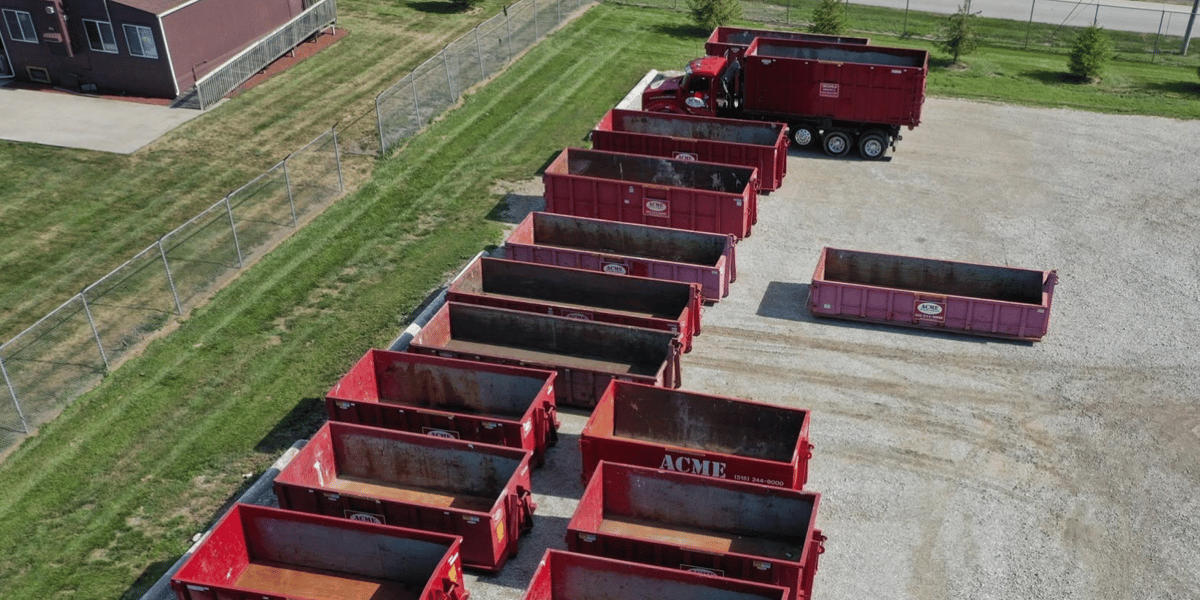
ACME Roll-Off Company is a family-run roll-off and dumpster company based in Des Moines, Iowa. It started in 2006 as an expansion of the family’s demolition business, which has been operating for nearly 100 years.
Ryan Nelson, a production manager on the ACME team, works alongside his wife and brother-in-law in a company owned by his father-in-law. Today ACME runs six roll-off trucks and around 150 to 160 dumpsters, serving its own demolition work and outside customers.
In this story, Ryan explains how ACME uses CRO to run dispatch, keep drivers moving, and track down containers that should be earning revenue somewhere else.
Manager, Production
ACME Roll-Off Company uses CRO to find idle containers, get drivers moving each morning, and keep a large container fleet working with a small crew.
✔️ 18 DAYS IDLE — Cans found in a single report. When the yard is empty and a new order comes in, ACME team can pull a report of his oldest cans in the field. In one example, it showed a can that had sat for 18 days, so Ryan could call the customer and get it moving to the next paying job.
✔️ 150–160 DUMPSTERS — Dispatched from one system. ACME runs its full container fleet from CRO, which it uses primarily for dispatching, with about two trucks on the road on a typical day.
✔️ “SOLUTIONS RIGHT AWAY” — Support that keeps one problem from becoming six. If something breaks, Ryan says CRO’s team responds with “no lag.” That matters to him because he “can’t wait three hours” for a fix.
ACME's roll-off operation was born out of necessity. With a demolition business dating back nearly a century, the family understood first hand how important dependable dumpster service was to keeping jobs on schedule. When outside providers couldn't keep up with the demands of their interior demolition crew, they decided to build that capability themselves.
Over time, what began as an internal solution became a service for other businesses facing the same challenges.
Today, ACME balances the needs of its own operation with those of outside customers. And with roughly 150 to 160 dumpsters in circulation, knowing where containers are, how long they've been on-site, and which ones can be redeployed is essential.
For Ryan, that comes down to making sure valuable equipment isn't sitting idle when another customer needs it.
In the roll-off business, a dumpster that's sitting too long at a job site represents an opportunity to put an expensive asset back to work.
Before implementing CRO, having clear visibility into container age and knowing which dumpsters were available for new jobs was a challenge. A container might remain idle at a customer's site for weeks or even months while another customer was waiting for that same size.
"That asset sits for months. It could be making money, [but] it's been sitting somewhere," Ryan explains.
With CRO, ACME can pull reports to identify its oldest containers and make more informed decisions about which dumpsters to retrieve. Ryan shares the example of a customer calling to request a 20-yard dumpster when there aren't any available in the yard.
"Now we have the feature of, you know, hey, I can run a report and I can figure out where my oldest cans are," he says.
Rather than relying only on what's physically in the yard, the team can look at how long containers have been sitting at customer locations and reach out to see whether they're ready for pickup. "That can's been there for 18 days. I'm giving that customer a call, telling him, 'Hey, I need that dumpster. Are you ready or you're not? 'Cause I'm gonna come pick it up.'
That visibility helps ACME make better use of its existing inventory and respond to new requests without immediately needing additional containers.
As Ryan puts it, the goal is simple: get the dumpster to the next customer and "start making money again."
For an operation managing multiple trucks, drivers, and customer locations, a straightforward dispatch process helps keep the day moving.
Ryan says one of CRO's biggest advantages is how easy it is for drivers to use.
"Very easy to use. It's just, it's driver-friendly," he shares.
Instead of starting the morning unsure of their assignments, drivers can open CRO on an iPad and review the work ahead.
"They get the iPad in the morning, scroll through it, and I'm doing this, this, this, and this," Ryan explains. Having that information readily available helps drivers understand their daily assignments and supports communication between the field and dispatch.
For ACME, where customer needs can change throughout the day, keeping drivers informed is an important part of maintaining service.
For a family-owned business like ACME, customer service is personal. Their family-first approach shapes how ACME treats its customers and what it expects from the companies it works with.
"There's a whole different service with family companies. I mean, they just care more. It's personal," Ryan says.
That same expectation carries over to ACME's relationship with CRO. When a dispatch or operational issue comes up, Ryan doesn't want to wait hours for an answer. One unresolved problem can quickly create additional challenges for trucks and drivers in the field.
"Because if there is fire right now, I need it put out right now. I can't wait three hours because that fire has caused six other fires on a truck."
Ryan says the responsiveness of the CRO support team has made a difference.
"We call if we've got an issue. And it's right away. They want to fix the problem as much as we need the problem fixed. I mean, there's no lag, there's no nothing. It's just right there."
For ACME, having a software provider that understands the pace of roll-off operations matters just as much as having the right features.
Technology helps coordinate the work, but Ryan believes the people behind the wheel are just as important to a successful roll-off business. Drivers aren't simply delivering and picking up dumpsters. They're often the people customers interact with most.
"They're the customer service agent. I mean, they are the ones that are dealing with that customer," Ryan explains.
In a competitive market where customers have plenty of dumpster rental options, those interactions can make the difference between keeping and losing business.
That's why having driver-friendly tools matters. When drivers can quickly understand their assignments and stay connected with dispatch, they can focus more attention on completing the job and serving customers.
For ACME, CRO supports that approach by making daily work easier to navigate while giving the office better visibility into the operation.
ACME Roll-Off has come a long way since it started purchasing dumpsters to support its family demolition business in 2006.
Today, the team is managing a growing container inventory, coordinating daily dispatch, and finding new ways to get more value out of the equipment it already owns.
From giving drivers a clear view of their assignments to identifying dumpsters that are ready to be put back to work, CRO is helping ACME manage the operational details that matter.
As Ryan says of the CRO team, "We appreciate everything you guys do. Make life easier."
Want to see how CRO can help your roll-off business simplify dispatch, track containers, and keep your dumpsters earning? Schedule a demo to talk with a team that understands your industry.
