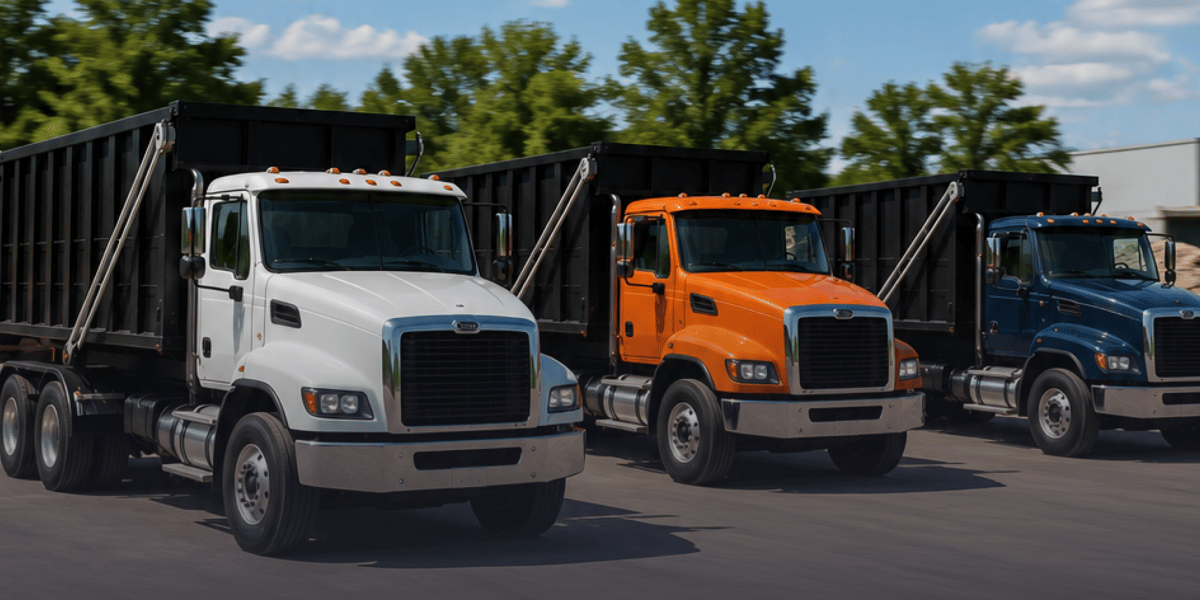
A truck sits at the disposal site, waiting its turn behind three others. A driver runs today's route the same way they ran it last Tuesday, and the Tuesday before that, because it's always been run that way. Nobody writes any of this down. Nobody puts a dollar figure on it. It's just Tuesday.
This isn't a sales pitch — it's a guide. Below, we'll walk through what idle time is actually costing roll-off, portable sanitation, and septic operators, using the same industry data fleet managers use to build their own case internally. Then we'll point you to a free calculator that runs the number for your fleet in under a minute.
Here's what the data says the number usually looks like, what goes into it, and where to plug in your own fleet to see yours.
Why Idle Time Is So Easy to Miss
Idle time never shows up as its own line on a P&L. A missed invoice is obvious — someone notices the bill never went out. Idle time isn't like that. It's buried inside your fuel bill, your labor bill, and your overtime line, and every one of those gets explained away individually: "fuel's just expensive right now," "that driver always runs long." No single number ever says "idle time cost you $200,000 this year," so nobody goes looking for it.
That's the trap. You can't fix what you haven't measured. The next section shows you exactly what goes into that number — and the calculator below does the math for you.
The Formula for Calculating Your Fleet's Idle Time Cost
The math itself is simple, even if nobody's actually run it for your fleet:
Number of drivers × average idle hours per driver per day × blended hourly cost (wage + burden) × working days per year.
"Idle" isn't just a truck parked with the engine off — it's any hour a driver and a truck are on the clock but not moving revenue forward: waiting in line at the disposal or dump site, backtracking because a route wasn't planned around today's actual stops, sitting on a dispatch delay while someone tracks down the next assignment.
Here's what that looks like for a mid-sized operation: 12 drivers × 2.5 idle hours/day × $28/hour blended cost × 260 working days = $218,400 a year. That's before counting a single gallon of extra fuel.
Skip the math — we built a free calculator that runs this for your fleet in under a minute.
How Much Does Truck Idle Time Actually Cost? What the Data Shows
Wherever your own number lands, the direction is consistent across every source we could find:
- Idling accelerates engine wear enough that the American Trucking Association estimates it adds roughly $2,000 per vehicle, per year in extra maintenance cost — a figure that shows up consistently across independent fleet-maintenance sources, not just one study.
- The U.S. Department of Energy's Argonne National Laboratory, which has studied idling fuel use for years, puts heavy-duty idle fuel burn at roughly 0.8 gallons per hour. At typical annual idle hours for a working truck, that lands in the $6,000–$8,000 per truck, per year range in fuel alone at current diesel prices.
- Route-optimization studies across the trucking and waste industries generally show 10–35% in potential cost savings once routes are actively managed instead of run on habit.
A note on sourcing: some of the sharper waste-industry-specific figures on idle cost circulating online — for example, "$4,000–$7,000 lost per truck per year" for waste fleets — trace back to a fleet-software vendor's own marketing content, not independent research. Treat those as industry estimates, not settled fact, and weight the ATA and DOE figures above more heavily since they're the more independently verifiable numbers here.
This is real, recoverable money — not a rounding error.
Why Whiteboard Dispatch Hides Idle Time Until It's Already Cost You
Most dispatch in this industry still runs on driver habit, a whiteboard, or a route sheet that hasn't been rebuilt since it was first drawn up. That's not a laziness problem — it's a process gap. Without a live view of where trucks actually are and how a route is actually performing, there's no way to spot the inefficiency until it's already cost you money. By the time anyone notices, it's manual detective work: pulling GPS logs after the fact, trying to reconstruct why a driver ran two hours long on a Thursday three weeks ago.
Operators approaching this today are moving toward real-time visibility into where every truck and driver is, and the ability to re-sequence a route in a couple of clicks when something changes mid-day — rather than rebuilding the whole day from scratch. That kind of live dispatch visibility is part of what a platform like CRO is built to give roll-off, portable, and septic operators, though that's a conversation for another day.
Stop Guessing — Calculate Your Fleet's Idle Time Cost Now
Idle time doesn't announce itself. It hides inside costs you've already learned to explain away — until you actually run the number. Now there's an easy way to see yours instead of guessing.
Try the free calculator — see your fleet's number in under a minute.
Already convinced this is bigger than you thought? Book a 15-minute discovery call with one of our experts to learn how CRO can help you reduce idle time.
Sources Cited
- American Trucking Association — idling-related maintenance cost estimate (~$2,000/vehicle/year), as reported via AtoB, Motive, and FleetOwner coverage.
- U.S. Department of Energy / Argonne National Laboratory — idling fuel consumption research (afdc.energy.gov), used as the basis for the $6,000–$8,000/truck/year fuel estimate.
- Route optimization savings range (10–35%) drawn from multiple independent trucking and waste-industry efficiency sources.
- Waste-industry-specific per-truck loss figures ($4,000–$7,000) originate from FleetRabbit, a waste-fleet routing software vendor — cited here as an industry estimate, not independent research. Recommend pairing with first-party CRO customer data once available for a stronger stat.



/TEST%20icons/noun-concrete-pump-5976240.svg)
/Industry%20Icons/noun-5917380.svg)
/Industry%20Icons/noun-truck-4140346.png?width=60&name=noun-truck-4140346.png)


/TEST%20icons/noun-crane-truck-6830557.svg)
/TEST%20icons/noun-drilling-5103943.svg)


/Industry%20Icons/noun-road-fence-3990160.png?width=60&name=noun-road-fence-3990160.png)

/No%20Background/noun-maintenance-7409171-F1612C.png?width=60&name=noun-maintenance-7409171-F1612C.png)