Concrete Pumping
From boom pumping to telebelts, we help concrete placement teams deliver best-in-class service with every job.


Roll-off operations
Updated November 2, 2026
Every roll-off dispatcher has had a Thursday like this one, so picture it through Luis, an imagined dispatcher at a twelve-truck roll-off company. At 10 a.m. the board looks fine. At 10:15 a driver calls from a driveway across town: a car is parked in front of the 20-yard she came to swap, and nobody answers the door. At 2:40 another driver calls from the landfill. A storm has closed the site, and he is sitting at the gate with a full 30-yard on the truck. At 3:00 a contractor asks for a 40-yard on site first thing tomorrow, and every 40-yard the company owns is already out.
Three exceptions, one afternoon. None of them is anyone's fault, and all of them land on the same desk while the phone keeps ringing. If your day has ever looked like Luis's, you are in good company. It happens at every roll-off company, usually on the busiest day of the week.
TLDR
To run a roll-off dumpster business through a bad afternoon, treat each exception as a small decision: the driver records a reason and photos, one named person decides, and the customer hears the same day. With CRO, we keep the original job and its history when it changes, so that decision reaches the office and the invoice.
The clean jobs take care of themselves. A swap that goes to plan gets closed by the driver, billed from the job and forgotten. The jobs that decide whether a day makes money are the ones that go sideways. That is why the real test of any software to run a roll-off dumpster business is what happens on the third exception of a bad Thursday, not on the first clean swap of a quiet Monday.
Exceptions decide the day because each one spends truck time without earning it. A blocked container is a trip with no swap at the end. A closed landfill is a loaded truck that cannot take its next empty container out. A job the yard cannot cover is revenue you either share or turn away. And every one of them pulls the dispatcher off the board at the moment the rest of the day needs attention.
Here is a rough cost for one wasted trip. Suppose it takes 1.25 hours of driver time and 25 miles. At the May 2025 median wage for heavy and tractor-trailer truck drivers of $28.19 an hour (U.S. Bureau of Labor Statistics), the driver time comes to about $35. At an assumed 5 miles per gallon and the U.S. on-highway diesel average of $6.352 a gallon for the week of October 26, 2026 (U.S. Energy Information Administration), the fuel is about $32. That is roughly $67 before truck wear, insurance and the paying swap that truck could have done instead. The hours, miles and fuel economy are assumptions for this example, so put in your own.
Public haulers price the same problem. Los Alamos County, New Mexico, charges a $105 service fee when a roll-off cannot be picked up because the container is blocked, and waives it if the renter fixes the problem so the container is serviced within 20 minutes of the driver's arrival. That is a useful way to think about it. A dry run is not a failure. It is a decision, with a paper trail, about who pays for a trip that did not work.
When a car blocks the container, the driver records why and shows it, the dispatcher decides what happens to the job, and the customer hears about it before the end of the day. Splitting the work three ways keeps the driver moving and keeps the decision with someone who can see the whole board.
At 10:15, Luis's driver had already knocked and waited. Her part was small and specific: one sentence of reason (car parked across the container, no answer at the door), two or three photos that show the car, the container and the street, and a call to dispatch. She did not quote a fee from the driveway, and she did not leave without the photos.
Luis then had four choices, and the rental terms decided which ones were open:
Luis reached the customer, who said the car belonged to a guest leaving after lunch. He moved the swap to 1:30 with a driver already working nearby and did not charge for the first trip. The failed attempt stayed on the job anyway. If the same driveway is blocked again next month, he will want the first time on record.
On a street placement, a parked car can be the city's problem as much as yours. San Diego, for example, requires the permit holder to post Tow-Away/No Parking signs 72 hours before placing a dumpster, and says vehicles parked in the surplus area of a dumpster zone are subject to parking citations. Where your container sits under a permit like that, the photo of the car is also evidence for the city.
This is the moment software either helps or gets in the way. More than 700 waste and site service companies trust CRO to run their operations, managing over 11 million jobs a year, and failed jobs are one of the places we built it for. With CRO, you can require a reason and photos for every failed job, and the office can then reschedule it, reassign it or charge a dry run without losing the job history. Routes update in the driver app in real time, so the 1:30 retry lands on the nearby driver's screen without another phone call. Customers who use our customer portal also get an automatic email when a job is marked failed, which backs up the office's call rather than replacing it.
Whether a dry run fee holds up when the invoice goes out is a separate check, made at the end of the day. Our end-of-day billing review for turning completed jobs into invoices covers which charges need which evidence.
When the landfill gate is closed, the driver should stop, call dispatch and, in most cases, turn the load into tomorrow's first job rather than chase a second site late in the day. A full truck idling at a locked gate feels urgent, but the bigger risk is the next two hours.
Disposal sites close earlier, and less predictably, than the hours on the sign suggest. Cumberland County, North Carolina, opens its Ann Street Landfill from 6:30 a.m. to 4 p.m. on weekdays, but accepts most loads only until 3:45 p.m. and requires customers to be offsite by 4 p.m.; if the gate is closed, there is no admittance. The same county says its sites may close temporarily for wind, lightning or fog, or for the day in severe weather. In Utah, Box Elder County requires all loads to pass through the bottom gate at least 15 minutes before closing time or they will not be unloaded. A truck that reaches a gate at 3:50 is as stuck as one that finds it locked by a storm.
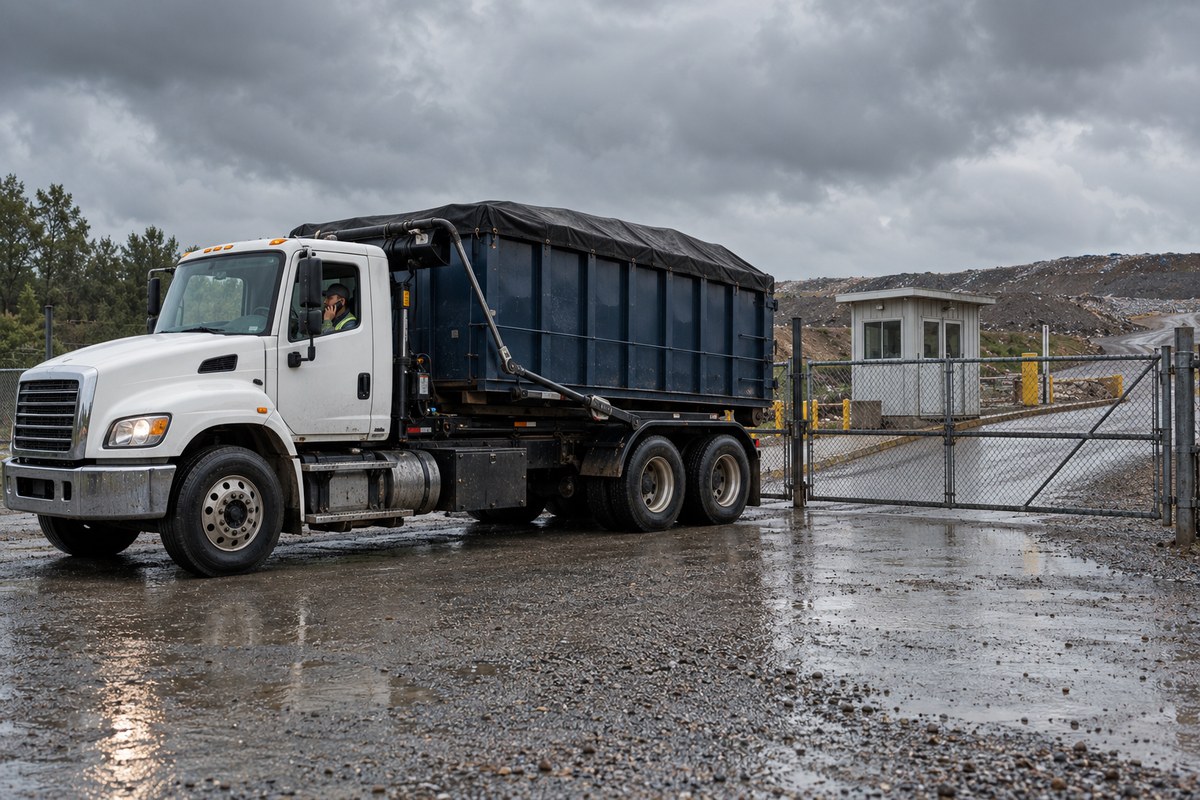
At 2:40, Luis had two options for the full 30-yard. The truck could try the next nearest site, if someone confirmed by phone that it was open and would take the load. Or it could bring the load back to the yard and dump first thing in the morning. Two things pushed him toward the yard.
The first was the driver's day. Drivers who run under the federal short-haul exception must return to the work reporting location and be released from work within 14 consecutive hours. A driver who started at 5:30 a.m. and spends late afternoon chasing a second landfill that may also be closing is spending hours he may need. The second was the load itself. Wherever it goes, it rides covered: federal rules require cargo on public roads to be secured to prevent it from leaking, spilling, blowing or falling from the truck, and Cumberland County adds a $25 fee for commercial vehicles that arrive without a covered load.
When a driver does head for a disposal site, CRO's driver app routes to the nearest dump or landfill from the truck's current location. If the load has to come back instead, the driver selects Return Full and chooses a yard, and a dump job is created for the next day or for another truck. What CRO does not do is know a disposal site's opening hours or weather closures. That call, or a look at the site's posted hours, stays with your team. Luis had the driver select Return Full, made the dump the first job on Friday's board, and called the one customer whose afternoon swap now had to wait for an empty container.
A job should go to an outside hauler when your own yard cannot cover it and turning it away costs more than sharing it, and only if the job stays on your own record. Otherwise the customer is yours on the phone and somebody else's in the driveway.
At 3:00, the contractor wanted a 40-yard by 7 a.m., and Luis's inventory showed every 40-yard on rent. That is the first thing to know for sure, and a clear view of roll-off container inventory, itemized by job turns it into a ten-second check instead of a walk around the yard. Luis called a hauler the company works with, confirmed a 40-yard and a delivery time, and booked it.
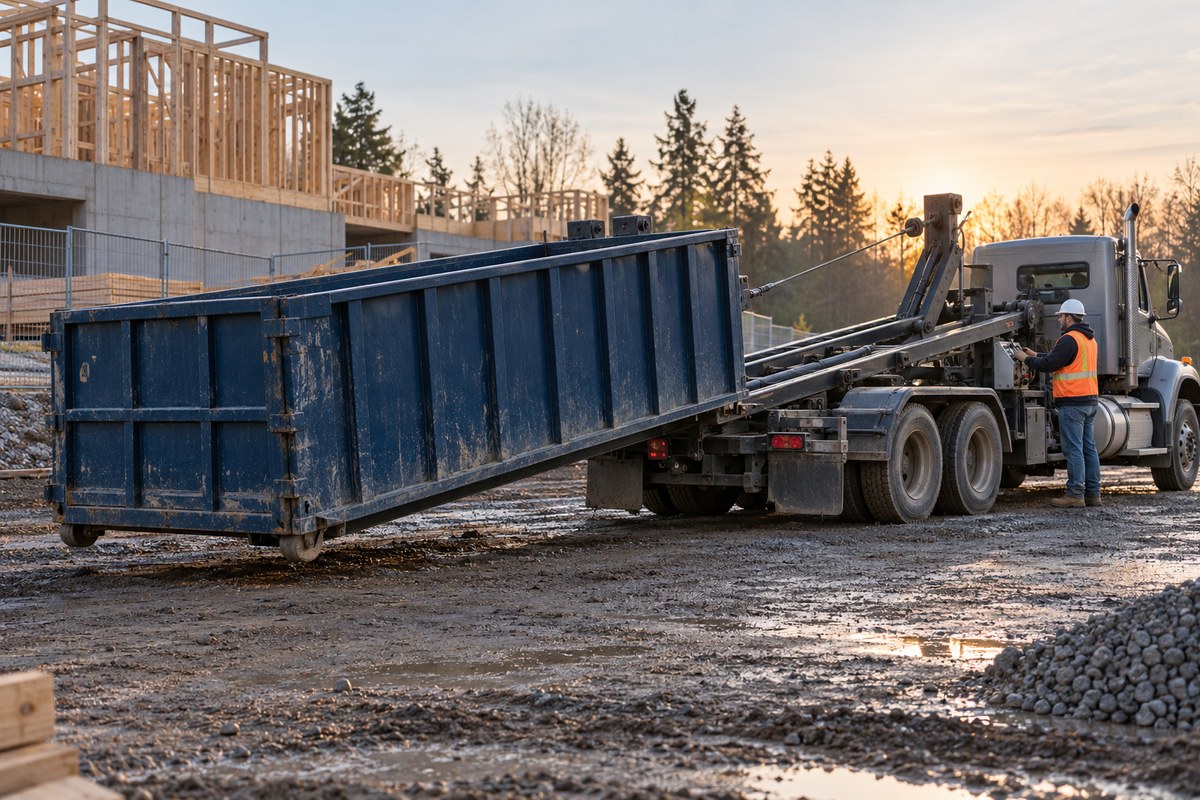
Sending work out is a business decision, so we suggest deciding ahead of time who is allowed to make it and at what price, rather than leaving it to whoever answers the phone at 3:00. The customer should also hear, at booking, that a different truck is coming and when. A contractor who sees an unfamiliar truck at 7 a.m. and was not told will call your office, not theirs.
Our Third Party Hauler App lets you assign and track jobs for outside fleets, so the work stays visible even when it goes outside your trucks. Luis's 40-yard stayed one job on his board, with the outside hauler assigned to it. The handoff itself, from site instructions to proof and charges, is covered in our guide to keeping outside haulers in one job record during a roll-off handoff.
A roll-off exceptions checklist is five steps that every exception runs through, whatever caused it. Luis's three exceptions had different causes, but each one needed the same things: a record, a decision, a call and one place to keep it all.
Who decides and how fast the customer hears depends on the exception. Here is a simple split that fits most yards:
| Exception | Who decides | When the customer hears |
|---|---|---|
| Blocked container | Dispatcher on duty, under the rental terms | Before the truck leaves the street, or within the hour |
| Closed landfill | Dispatcher, with the driver's hours in mind | Same afternoon, if a later swap has to move |
| Job sent to an outside hauler | Owner, or the person they name in advance | At booking, with whose truck is coming and when |
Customers notice how a problem is handled, not only that it happened. In a peer-reviewed study of service failures, Amy Smith, Ruth Bolton and Janet Wagner found that customers prefer a recovery that matches the type and size of the failure. Earlier work by Smith and Bolton found that excellent recoveries can raise satisfaction, but treating failures as a chance to impress customers carries real risk. For a dispatcher, that translates simply: call quickly, explain plainly, and offer a fix that fits the problem.
Software should keep the record, and people should make the calls that depend on context. Some exceptions are judgment calls that no system ought to make on its own.
Our software does not decide whether a fee is fair, whether a storm counts against the customer, or whether a long-standing contractor gets a pass. It makes sure that whoever decides has the reason, the photos and the job history in front of them, on the same record dispatch and billing already use. If you are still moving between separate tools for those three jobs, our guide to running dispatch, driver tracking and billing from one waste operations platform explains what changes when they share one record.
The next bad Thursday should look shorter, because every exception follows the same five steps. Picture how it could go for Luis the following week: a locked gate at a commercial site at 9:40 and a customer who has moved a 15-yard behind a garage. Each driver sends a reason and photos, Luis decides both within ten minutes, and both customers hear from the office before lunch. At the end of the day, the billing review finds the photos already on both jobs.
That is what makes the routine reliable: the record the driver starts at the curb is the same one the dispatcher decides on and billing checks, with nothing retyped in between. Here is the rule we suggest keeping by the dispatch desk. Feel free to print it:
Try it on your next bad afternoon. The first one will still be busy, but every decision will have a reason behind it, and none of them will be waiting for you on Friday morning.
Want to see a failed job, its photos and its reschedule on one record before your next bad Thursday?
You need dispatch, a driver app and billing working from the same job record, plus a way to handle the jobs that go wrong. Look for software that lets you require a reason and photos on a failed job and lets the office reschedule, reassign or charge for it without starting a new job. We built CRO to do both.
No. Charge it when the rental terms allow it and the photos show the problem. If the customer answers quickly and clears the way, a short wait or a reschedule often costs less than the argument. Either way, keep the failed attempt on the job so a repeat at the same address is on record.
Call dispatch before driving anywhere. Unless another site is close, open and takes the load, the safer call is usually to secure the load, take it back to the yard and make the dump the first job the next morning or give it to another truck.
The same day, and ideally before the truck leaves the street. A short call from the office with the new time and any charge heads off most complaints. An automatic email is a useful backstop, not a substitute for the call.
It should. Assign the outside hauler inside your own job record so the booking, proof of service and charges stay together, and tell the customer whose truck is coming.