


Concrete Pumping
From boom pumping to telebelts, we help concrete placement teams deliver best-in-class service with every job.
/TEST%20icons/noun-concrete-pump-5976240.svg)
/Industry%20Icons/noun-5917380.svg)
/Industry%20Icons/noun-truck-4140346.png?width=60&name=noun-truck-4140346.png)


/TEST%20icons/noun-crane-truck-6830557.svg)
/TEST%20icons/noun-drilling-5103943.svg)


/Industry%20Icons/noun-road-fence-3990160.png?width=60&name=noun-road-fence-3990160.png)

/No%20Background/noun-maintenance-7409171-F1612C.png?width=60&name=noun-maintenance-7409171-F1612C.png)


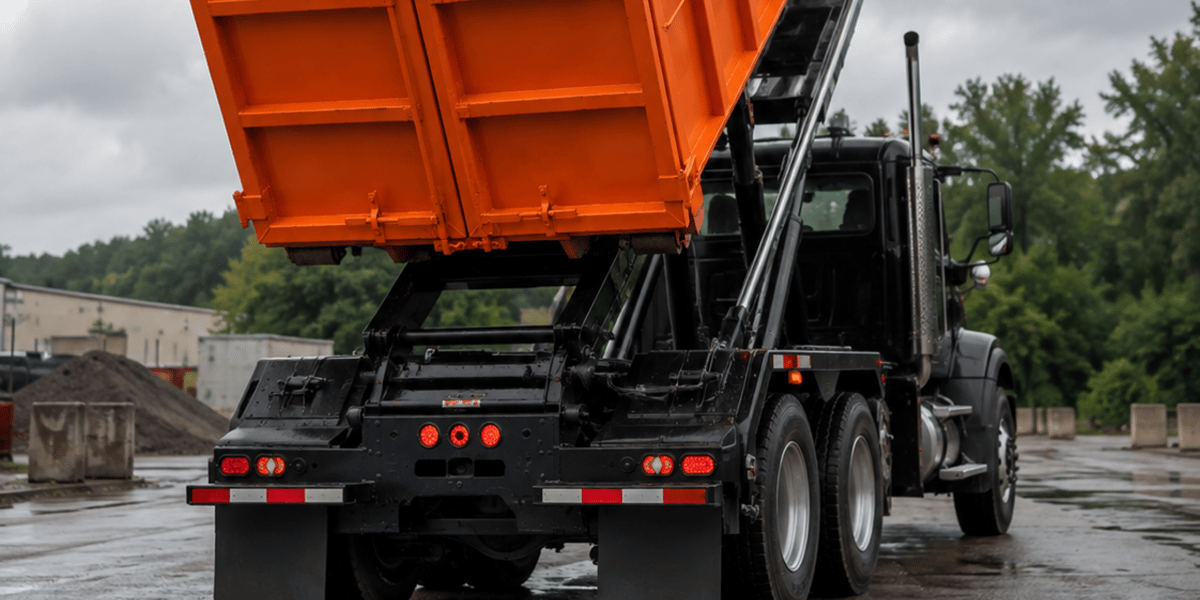
Roll-off work looks routine right up until it isn't. Waste collection had a fatality rate of 37.4 deaths per 100,000 workers in 2024 — the fifth deadliest occupation in the U.S., behind only logging, fishing, roofing, and structural ironwork (BLS data, reported by Waste Dive). Transportation incidents remain the single leading cause of death in the industry, just as they are across nearly every occupation nationally.
The good news: most of that risk concentrates in a handful of repeatable moments — backing up, raising the bed, placing a container, running the hoist — not random bad luck. Here are seven hazards worth knowing, the equipment that mitigates them, and five procedures worth covering in your next safety talk.

Struck-by incidents involving a vehicle or mobile equipment account for roughly 30% of fatalities in the refuse industry (U.S. Bureau of Labor Statistics), and a NIOSH review of construction dump truck incidents found 809 worker deaths between 2011 and 2020 — with blind spots directly behind the truck, near the front bumper, and on the passenger side identified as the most dangerous zones.
PRO TIP Never back up without a trained, dedicated spotter and a confirmed go-ahead — not just a wave, an actual confirmed signal before the truck moves.
BLS data shows that free body movement — largely workers jumping on and off trucks — accounts for roughly one-eighth of nonfatal injury sources industry-wide, and falls from a truck are frequently the first event in a fatal run-over, since a fallen worker can end up in the vehicle's path.
PRO TIP Use grab handles and maintain three points of contact climbing on or off the truck — never jump down, no matter how convenient it seems in the moment.
Insurance-industry safety guidance identifies three failure modes specific to roll-off and dump trucks: direct contact with an energized line while raising the box, "bridging" electricity to the truck body that energizes the truck and surrounding ground, and lowering the box onto wires and pulling poles or lines down onto the truck.
PRO TIP Visually locate all overhead lines before raising the bed, know the voltage-based clearance distance, and always lower the bed fully before moving the truck.
NIOSH identifies unstable or soft ground, uneven or sloped terrain, and improperly distributed loads — material piled high toward the front — as the leading contributors to tip-overs and loss-of-control incidents in this equipment class.
PRO TIP Survey the ground before placing a container — level and firm, with plywood underneath on soft ground — and never let a load pile heavier on one side.
Cable hoist manufacturers flag four recurring failure modes: overloading the hoist, dropping the load, the cable breaking mid-operation, and transporting a truck with the hoist still elevated.
PRO TIP Inspect the cable and hoist before every single use — not weekly, not "when it looks off" — and never move the truck with the hoist raised.
Overexertion — predominantly lifting — causes close to a third of all nonfatal injuries in the waste industry, and sprains, strains, and muscle tears alone make up 48% of nonfatal injury types (BLS).
PRO TIP Never manually reposition a heavy container alone. Use proper lifting technique, and treat "I'll just muscle it" as the warning sign it is.
Cuts, lacerations, and punctures account for about 18% of nonfatal injuries industry-wide, and containers themselves are the injury source in roughly a third of all cases (BLS) — sharp debris, exposed nails, and improperly bagged hazardous items are common culprits.
PRO TIP Visually inspect a container's contents before handling it, wear cut-resistant gloves and eye protection, and never reach blindly into a load.
Once your crew understands these seven hazards, the right equipment makes avoiding them a habit rather than a judgment call every time:
Daily or weekly toolbox talks are the right venue to keep these front of mind — they don't need to take more than a few minutes each:
None of these procedures matter if they only live in a safety-talk slide deck. CRO's driver and asset safety logic lets your crew log pre-trip inspections and flag hazards directly from their phone, and the same proof-of-service photo capture that documents a billable job also creates a timestamped record if an incident ever needs to be reviewed.
Book a discovery call today to see CRO's safety and driver workflow tools in action.