


Concrete Pumping
From boom pumping to telebelts, we help concrete placement teams deliver best-in-class service with every job.
/TEST%20icons/noun-concrete-pump-5976240.svg)
/Industry%20Icons%20(Placeholder)/noun-5917380.svg)
/Industry%20Icons/noun-truck-4140346.png?width=60&name=noun-truck-4140346.png)


/TEST%20icons/noun-crane-truck-6830557.svg)
/TEST%20icons/noun-drilling-5103943.svg)


/Industry%20Icons/noun-road-fence-3990160.png?width=60&name=noun-road-fence-3990160.png)

/No%20Background/noun-maintenance-7409171-F1612C.png?width=60&name=noun-maintenance-7409171-F1612C.png)


Working with heavy machinery reasonably leaves you with lots to consider, from how to maintain operational safety to how to keep the equipment always running and performing its best. Preventive maintenance helps ease these worries, but it sometimes comes too late, being overlooked among the many other tasks.
Heavy equipment maintenance logs are there to save the day and keep your fleet ready to take on jobs at a moment's notice. Many large or fast-growing fleets rely on software, including RapidWorks' Rapid Fleet, to automatically track their maintenance requirements. However, brand-new heavy equipment service teams might be looking for a smaller and easier place to start, such as user-friendly spreadsheets.
Discover how heavy equipment maintenance spreadsheets can help you track key metrics, boost profits, and keep operations safe and compliant with minimal effort.
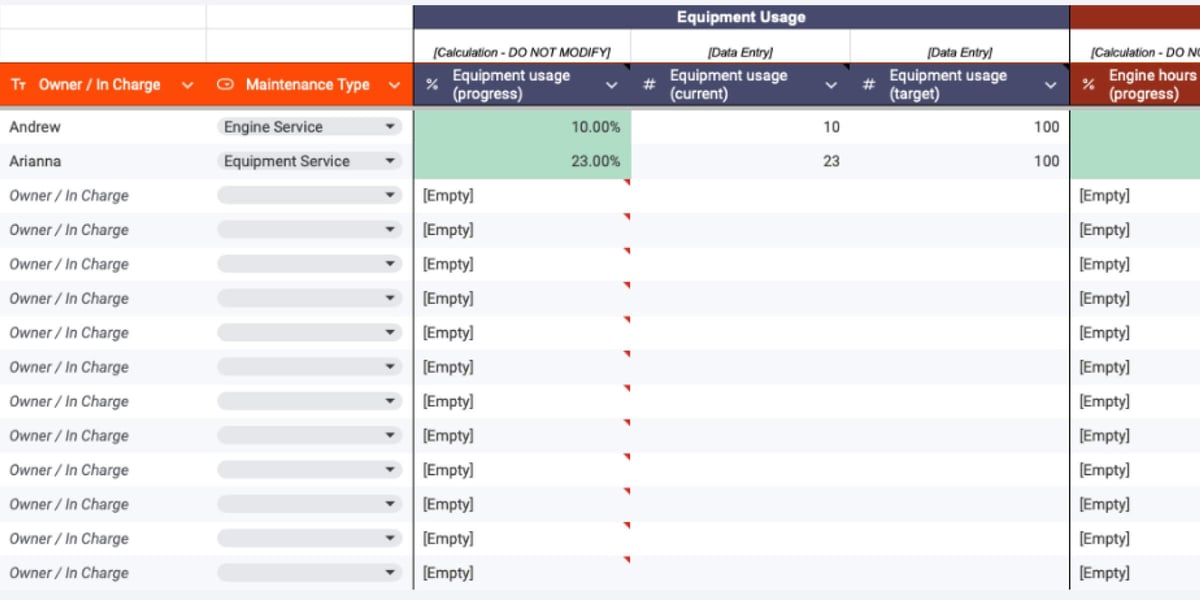
We built our free heavy equipment maintenance tracking spreadsheet to give you an easy way to track your fleet's upcoming maintenance. From annual inspections to regular engine service and equipment checks, this equipment maintenance log includes pre-built templates to help you track your most common maintenance types.
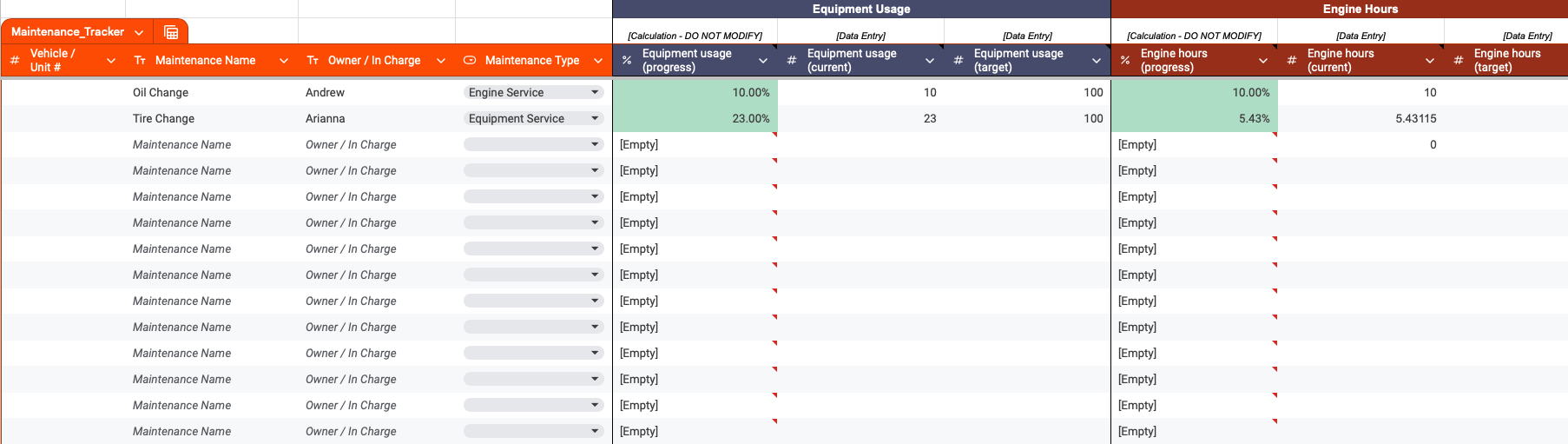
Access your free heavy equipment maintenance tracking spreadsheet here.
Even if you don't find anything wrong, frequently inspecting and maintaining your heavy equipment is essential for your operations. Explore the key benefits of using equipment maintenance logs.
Effective equipment maintenance logs eliminate emergency costs and minimize work disruptions by establishing a consistent maintenance schedule. Consider this: Being forced to pull a truck off a project for last-minute maintenance can delay the job, as the equipment can't even be used on other worksites. Even worse, this negative experience may lose a customer entirely or force you to turn away potential jobs that arise during your downtime.
Any truck that's stuck in the shop instead of working on the job site isn't contributing to your revenue. These non-billable hours can stack up fast and limit profits.
Avoid snags caused by maintenance, such as not having enough trucks or having to perform tasks manually, by using a heavy equipment maintenance log to set a routine schedule. Following a heavy equipment maintenance schedule helps you keep your equipment running smoothly by issuing repairs in phases. This way, you know ahead of time when trucks will be in the shop getting mandatory maintenance done.
Of course, your maintenance schedule should also include regular equipment tests and inspections. Thorough inspections let you identify and handle potential issues before they become costly and time-consuming. Done correctly, this phased approach significantly increases the likelihood that you always have working equipment ready for a job, contributing to fewer breakdowns and more billable hours.
Ultimately, planning for maintenance ahead of time means you know exactly when your trucks will be active and inactive. This puts the control back in your hands, resulting in less severe and non-disruptive repairs.
Comprehensive equipment maintenance logs will also track your equipment's most common issues and maintenance needs. This can help you plan for frequent issues or even find ways to avoid them entirely. For instance, if trucks that regularly drive over unkept roads get flat tires too frequently, you could invest in extra spare tires or heavier-duty tires for your whole fleet.
Properly using heavy equipment maintenance spreadsheets helps you maintain a safer work environment. Simply put, heavy equipment is safer to use when it functions properly. Frequent maintenance, inspections, and tests minimize the risk of malfunctions and boost employees' trust in your equipment.
Prioritizing employee safety with regular maintenance will also keep your organization compliant with Occupational Safety and Health Administration (OSHA) requirements. Additionally, updated maintenance logs provide your organization with a clear paper trail to prove that you've followed safe and legally compliant practices.
Using heavy equipment maintenance templates can also reduce your organization's spending beyond direct maintenance costs. For instance, heavy vehicles that aren't functioning properly generally have worse fuel efficiency, which can drive up mileage costs. Minimizing emergency repairs also reduces other operational costs caused by the setback, such as having to bring employees on-site for two days rather than one.
Using a heavy equipment maintenance template is a great first step to building safer and more reliable workplace operations. However, every organization is different, so there's no one-size-fits-all spreadsheet strategy. Tailor your spreadsheet to address your business's unique needs.
Before customizing your heavy equipment maintenance spreadsheet for your organization, learn about the different types of preventive maintenance to track:
Most heavy equipment requires you to track multiple metrics at once and perform maintenance based on which interval comes first. For example, a truck may need to be inspected every 3 months or every 15,000 miles, depending on the specific requirements. So, if it reaches 15,000 miles after two months, you should get it checked out as soon as possible rather than waiting another month.
A proper heavy equipment maintenance spreadsheet will help track engine maintenance, equipment maintenance, and regular inspections based on usage and maintenance type.

Using a spreadsheet to track maintenance can work for small fleets, but manually keeping tabs on every piece of equipment can become a burden as your fleet grows. For instance, recording engine hours or equipment usage every day would mean manually checking each piece of equipment and punching it into the spreadsheet (which counts as work hours, too). Relying on daily checks can eventually lead to errors, and when maintenance is concerned, those errors often lead to costly downtime.
As your fleet grows, consider upgrading from a manual spreadsheet to an automated maintenance tracking system. These programs use your fleet's telematics data to stay up to date, so you don't have to manually keep track of equipment usage. These automated equipment maintenance logs will then proactively send you alerts when maintenance is coming up.
Best-in-class fleet management systems like Rapid Fleet are useful for more than just your maintenance team. By displaying when maintenance is required for every truck and piece of equipment, they help dispatchers plan in advance and build smarter schedules that account for downtime before maintenance even gets scheduled.
Schedule a demo with RapidWorks today to maximize your equipment maintenance logs.
Start with the equipment ID, make, model, serial number, year, current engine hours or mileage, work completed, completion date, technician, and next due date. For covered commercial motor vehicles, 49 CFR 396.3 specifically requires vehicle identification, the nature and due date of maintenance, and dated records of inspections, repairs, and maintenance.
There is no single interval for every machine. Follow the equipment maker's schedule and any rule that applies to the vehicle or worksite. For construction motor vehicles covered by OSHA 1926.601, crews must check specified safety items at the beginning of each shift and correct defects before the vehicle returns to service.
Track every measure that applies to the equipment. Engine service may be due after a set number of operating hours, vehicle service may depend on mileage, and inspections or component checks may follow a calendar schedule. Complete the work when the first applicable limit is reached.
A spreadsheet can support recordkeeping if the required information stays complete and current, but the spreadsheet alone does not make an operation compliant. Covered motor carriers must keep the records listed in 49 CFR 396.3, while OSHA requires specified construction vehicles to be checked at the start of each shift and defects corrected before use.
Move when staff spend too much time copying meter readings, service dates get missed, several people maintain different versions, or dispatch cannot see which equipment is out of service. Maintenance software becomes useful when the team needs automatic meter updates, reminders, shared work orders, inspection follow-up, and one current equipment status.
Rapid Fleet can sync odometer readings from GPS or telematics, alert the team when service thresholds are near, convert maintenance tasks and inspection findings into work orders, and sync out-of-service status with job management. It also keeps repair notes, signatures, parts, inspection records, and vehicle history together.