Concrete Pumping
From boom pumping to telebelts, we help concrete placement teams deliver best-in-class service with every job.


Roll-off dispatch
Updated November 14, 2026
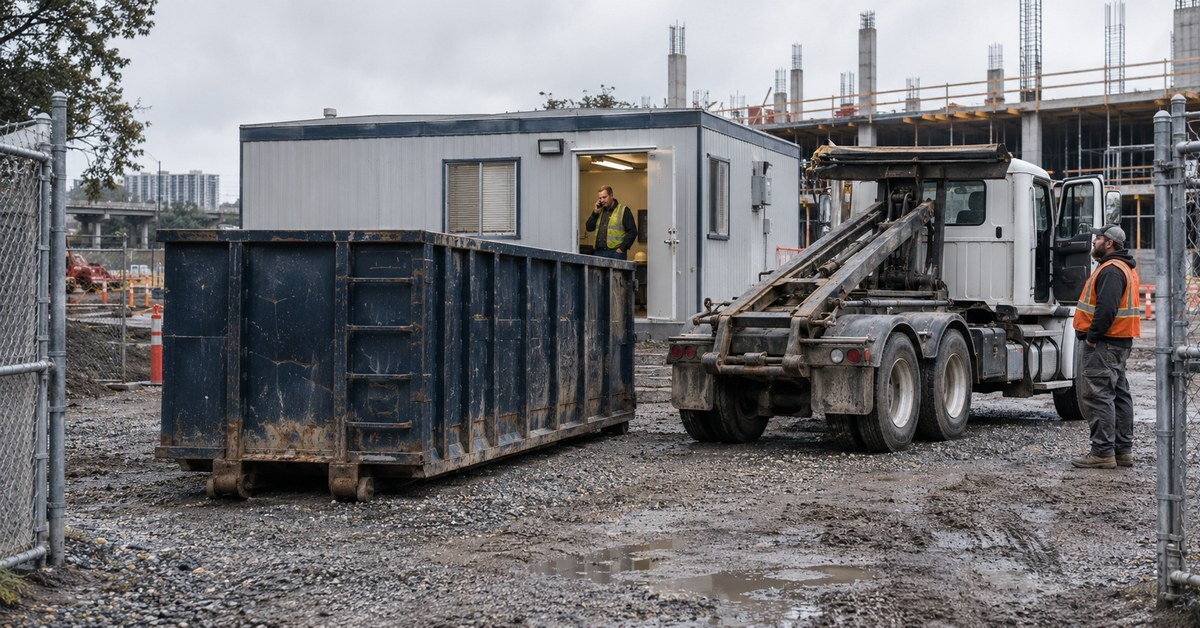
Cover: A roll-off truck and container beside a site trailer, with workers at the truck and doorway.
TLDR
Compare the location, unit, service window and caller's authority, then confirm whether the call repeats, changes or adds work. Keep one job for a confirmed repeat or agreed amendment. Book another only for a separately confirmed movement, and hold anything unresolved. CRO gives dispatch portal requests, job status and driver-entered container locations to check.
Luis runs dispatch for a roll-off company that serves a lot of general contractors. At 6:50 one morning the customer portal shows a new request from a site superintendent: swap the 30-yard at the Harbor Road project. At 7:40 the phone rings. It is a foreman for the same contractor, asking for a 30-yard swap at the west gate.
Luis knows two jobs that this contractor's crews call the west gate: the Harbor Road site, which has a west entrance, and a warehouse lot on Mill Street behind an old gatehouse. Book one swap, and a full container might sit at Mill Street all day. Book two, and a truck might haul a clean 30-yard to a site that already got one. Anyone who has dispatched for long has taken this call.
Online booking did not end phone orders. It gave the same customer a second door, so one swap can arrive twice, or two swaps can arrive sounding like one. Neither is anyone's mistake. The office needs a consistent check for every second message, including confirmation of what the caller wants done.
A portal creates near-duplicates because it adds a channel without closing the old ones, and commercial accounts have several people who can use each one. The superintendent who likes the portal and the foreman who likes the phone work for the same customer, often on the same morning.
A portal request may already be open when someone else on site calls the office. The caller may want the same swap, a change to it or another movement. A familiar customer name and container size cannot tell dispatch which.
Treat the second message as work to confirm. We suggest comparing its site, unit and requested day with the open request, then confirming the intended work with an approved contact. Ignoring it as a duplicate can leave a full container waiting; booking it straight away can send a truck twice.
Write the call down first because a caller's words can only be compared once they are on the record. Site nicknames, container sizes and relative dates such as tomorrow mean different things to different people, and memory fills the gaps with whatever job was on your mind.
Keeping records of requests is already in the job description: O*NET's dispatcher profile includes work orders and records of customer requests. Put the new call note beside the original request reference so the next dispatcher can see what changed. Its order-clerk profile adds a useful check: compare order information with earlier records and send incomplete orders for further processing. For Luis, that means leaving the second instruction open until he knows which west gate the foreman means.
Location is where the confusion usually starts. The U.S. Postal Service's addressing standard, Publication 28, gives part of a property its own place in an address through secondary unit designators such as building, suite and unit. A mailing address alone may not identify the gate or drop spot. We suggest recording that detail in the job notes and comparing it with the container's map pin. GS1's location guidance distinguishes a delivery location from an invoicing location. We suggest the same distinction in your site records: the contractor can have one billing address and two delivery sites, each with its own entrance detail. Before comparing anything, Luis asked the foreman for the street, a landmark and which container needed to go. The answer: Mill Street, behind the gatehouse.
Location, unit, service window and caller authority help dispatch compare a swap call with an open portal request. They are clues to the intended work. Complete the check and confirm whether the caller is repeating, changing or adding a movement before releasing it.
For Luis, Mill Street and a different 30-yard pointed to possible additional work, with both swaps wanted that day. He still needed confirmation: the foreman was not on the account's approved list for Mill Street.
The confirmed intent and authority put the second swap message in one of three branches. A repeat and an agreed amendment both stay with the existing movement; only separately confirmed additional work gets another job.
| What the check found | Decision | What dispatch does next |
|---|---|---|
| Approved contact confirms repeat or amendment | One movement | Keep one job; record the call and any agreed change |
| Approved contact confirms an additional movement | Additional job | Book it separately; confirm both movements and their locations |
| Intent, details or authority remain unresolved | Hold new instruction | Confirm with an approved contact before booking or changing work |
Holding a request feels slower, but a wrong guess costs more. Say a truck runs a clean container to a site that did not need it: 1.5 hours of driver time and 30 round-trip miles at 5 miles per gallon. Driver time, distance and fuel economy are our assumptions; put in your own. At the national median wage for heavy and tractor-trailer truck drivers of $28.19 an hour in May 2025, the driver time is about $42. Six gallons of diesel at the U.S. average of $6.127 a gallon for the week of November 9, 2026 adds about $37. Assume another half hour of office time to untangle it. At the $24.20 median hourly wage for dispatchers in May 2025, that adds about $12. That is roughly $91 in wages and fuel alone, before payroll costs, truck wear or any lost rental income.
Luis's call landed in the hold branch. He kept the Mill Street swap off the board and called the project manager on file, who confirmed that both sites needed a swap. One phone call turned a guess into two confirmed jobs.
Every branch ends with a short confirmation that names the job, the location and the next step, without promising a time the route cannot keep yet. A time given before routes are built becomes a promise the driver inherits.
Confirm a service window after dispatch has checked the route and site constraints. Read back the site, unit, requested day and whether the instruction changes the open job or adds another movement, then ask the approved contact to confirm it. That last confirmation closes the loop in a repeat-back check, a communication method described by AHRQ. Record who confirmed the work and when, so the next person has the decision as well as the call note.
We suggest a short line for each branch:
A one-off residential order has fewer sites and contacts to distinguish. Still compare a follow-up call with that order before booking or changing work. The fuller check is especially useful when several people can order for several sites.
CRO gives dispatch online service requests, job status and mapped container locations to compare during a follow-up call. Our account portal also lets customers view invoices and payment history and pay online. Confirm which movement the caller authorizes and its agreed charge before treating the message as additional billable work.
The recorded locations give Luis another useful check on which 30-yard the foreman means. With current driver-entered pins, he can distinguish the Harbor Road container from the Mill Street container. More than 700 waste and site service companies trust CRO to run their operations, managing over 11 million jobs a year. Your dispatcher still confirms the caller's authority, whether the call repeats or changes an open request, and the account's agreed terms before releasing work.
For the booking side, see our guides to account portals versus website checkout and online dumpster booking controls; for keeping pins current, our daily container count.
For an owner handling a few single-site orders, an Excel request log beside your existing invoicing process may be enough if you can keep both current. One follow-up call alone is not a reason to buy a broader dispatch system. CRO earns its place when several people need shared requests, job status, placements and account payments. We suggest keeping the three-branch table by the phone, then testing two real request records with your team.
Bring a portal request and a follow-up call to a CRO demo, and walk through the request, job status and mapped container location with dispatch.
The CRO customer portal has built-in guardrails that prevent duplicate portal requests. When a swap call, text or email arrives outside the portal, compare it with the open job and confirm the intended work before booking or changing anything.
An authorized caller is a contact the account has approved to order service, usually listed by name on the customer record. If a caller is not on that list, call back an approved contact on the number already on file before you book or change a job. For a phone call about a portal swap, have the approved contact confirm the intent: keep one job for a repeat or agreed amendment, book a second only for a confirmed additional movement, and hold unresolved instructions.
First compare the caller's site and unit with the open portal swap, and confirm whether the call repeats, changes or adds a movement. Give a service window after dispatch has checked the route and site constraints, so the time you give is one the driver can keep.
Ask for the street, a landmark and the container size, then compare those with the open job and the container's pinned location. If the answers still point to more than one site, hold the request and confirm with an approved contact.
For a follow-up on a residential dumpster order, compare the address, container and requested day with the open job. Confirm whether the call repeats, changes or adds a movement, and check the caller's authority before booking or changing work.