

Concrete Pumping
From boom pumping to telebelts, we help concrete placement teams deliver best-in-class service with every job.
/TEST%20icons/noun-concrete-pump-5976240.svg)
/Industry%20Icons/noun-5917380.svg)
/Industry%20Icons/noun-truck-4140346.png?width=60&name=noun-truck-4140346.png)


/TEST%20icons/noun-crane-truck-6830557.svg)
/TEST%20icons/noun-drilling-5103943.svg)


/Industry%20Icons/noun-road-fence-3990160.png?width=60&name=noun-road-fence-3990160.png)

/No%20Background/noun-maintenance-7409171-F1612C.png?width=60&name=noun-maintenance-7409171-F1612C.png)


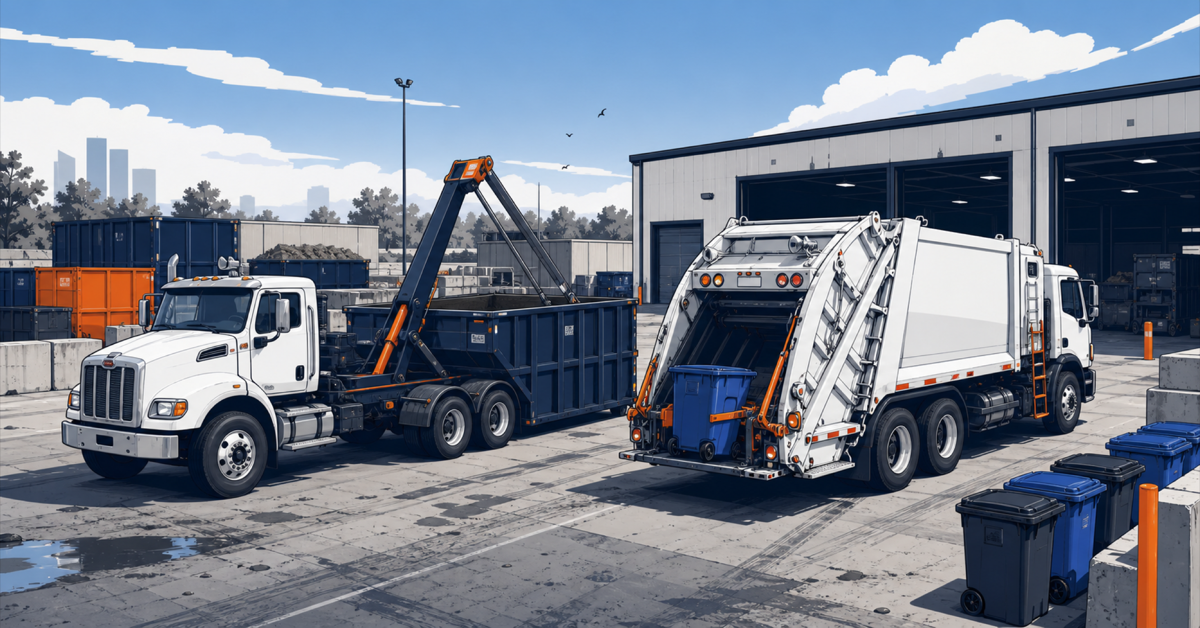
Routeware Elements and CRO Software both put a dispatch board, a driver app and billing in one system, and the demos look similar. The difference shows up in what each was built to run. One was built for municipal collection at city scale. The other was built for a private hauler juggling service lines that do not behave the same way.
Every claim below cites the exact vendor page it comes from, and the section at the end names the operation where Routeware Elements is the better choice.
Quick answer
CRO is the stronger fit for a private roll-off, portable sanitation, septic, or scrap and metal operator that wants dispatch, driver work, and billing connected in one system across more than one service line. Routeware Elements is the stronger fit for a waste or recycling hauler, or a city and county public works department, that needs deep municipal route optimization, compliance reporting, and a single platform spanning back-office, in-cab, and resident self-service.
We looked for solutions that connect dispatch, field work, and billing without a second system for reconciliation. Six criteria drove the comparison.
01Service-line scope
We checked whether the platform runs one waste or site-service line or several, and what changes in price or setup when an operator adds a second line.
02Container and asset visibility
We looked for software that tracks each container, bin, or unit on its own record, with location and service history, rather than flattening a multi-unit site into a single job.
03Dispatch and routing
We looked at how each platform builds and adjusts routes, including same-day changes, unassigned work, and route optimization at scale.
04Field to invoice
We looked for proof of service (photos, notes, signatures) and completed work flowing into billing without office staff re-entering what a driver already recorded.
05Buyer type and target market
We checked whether the platform is built for private commercial operators, municipalities, or both, since that shapes everything from compliance reporting to contract length.
06Independent review evidence
We checked Capterra ratings and review volume for both products rather than relying on either vendor's own claims about user satisfaction.
| Capability |  CRO CRO |  Routeware Elements Routeware Elements |
|---|---|---|
| Roll-off and dumpster dispatch | Yes | Yes |
| Driver app with proof of service | Yes | Yes |
| Customer self-service portal | Yes | Yes |
| Container and asset aging reports | Yes | Nonot the product's focus |
| Built for municipal and government contracts | Nonot the target market | Yes |
| Portable sanitation, septic, and scrap in one system | Yes | Nonot the product's focus |
| Public pricing listed online | No | No |
The table shows a fit decision, not a feature-count contest. Routeware Elements leads on municipal depth and back-office-to-in-cab consolidation for a single-line hauler. CRO leads on multi-service coverage and asset-level tracking for a private operator running more than one line.
Best for
A private roll-off, portable sanitation, septic, or scrap and metal operator running, or planning to run, more than one service line.
Pricing
A flat monthly base fee plus a per-truck fee, quoted after a demo.
What it is. CRO was founded by former waste operators in 2013 and joined RapidWorks in 2025. It connects dispatch, field work, billing, and collections for asset-centric waste and site-service operators. It runs across roll-off, with additional support for portable sanitation, septic, and scrap and metal recycling, in one platform.
Where it wins. Routing, and unified dumpster plus route dispatch, are consistently rated top of the industry: a drag-and-drop board unifies container-level jobs (deliveries, exchanges, swaps, pickups) and route-level assignments on one screen. On Capterra, CRO Software Solutions rates 4.3 out of 5 across 54 reviews, with ease of use at 4.4 and customer service at 4.6 [9]. The driver app captures "Photos, notes, and customer signatures captured on-site and attached to the job record" [14], and completed jobs turn into invoices automatically. CRO users can set up their customers with their own online booking portal, so they can continue to request services directly online: the portal lets customers "self-serve" for "swap requests, pickups, online payments, and service history" [14].
Where to look closely. A single-truck, roll-off-only operator with no plans to add another service line may find more platform than needed here. CRO does not target city and county government contracts the way Routeware Elements does, so an operator bidding on municipal collection RFPs should compare that fit specifically.
The verdict. The stronger fit for a private operator that wants container-level visibility, more than one service line, and field-to-invoice billing without a second reconciliation step.
Best for
A waste and recycling hauler, or a city and county public works department, that wants one platform spanning back-office, in-cab, and self-service.
Pricing
Custom-quoted only. No public number.
What it is. Routeware Elements is purpose-built waste and recycling software, the flagship hauler product inside a family of eight named Routeware products. Routeware's own site describes Elements as making it easy for a team "to increase productivity through process automation and business decisions with actionable insights" [2].
Where it wins. Routeware Elements and its sibling government product, SmartCity, target municipal and county fleets directly, with a product line built for that buyer. CRO serves haulers who hold municipal contracts, and it has no government specific product. A review site describes Routeware as using "combinatorial optimization engines (similar to vehicle routing problem solvers) that factor in truck capacity, service windows, container size, collection frequency, and road network constraints simultaneously" [10], and names Routeware among the platforms that "lead for municipal and commercial scale" [10]. Routeware's own site states the company "has been at the forefront of digital transformation in the waste and recycling industry for over twenty years" [4], and lists 1,500 customers, 88 million residents covered, and 18,000 trucks running its technology company-wide [4].
Where to look closely. Routeware Elements is built for waste and recycling collection. It does not run portable sanitation, septic, or scrap and metal recycling the way CRO does, so an operator adding one of those lines would need a second system. Reviewers on Capterra rate Routeware 4.5 out of 5 across 11 reviews [7]. One three star review describes real friction on both counts: time spent each cycle auditing billing for accuracy to avoid lost revenue, and recurring dispatch-map lag [7]. Elements is not the same product as Routeware's own municipal SmartCity line, so a private hauler should confirm which product a demo actually shows.
The verdict. The stronger fit for a waste and recycling hauler or a municipality that needs deep route optimization and government-grade compliance reporting, and does not plan to run portable sanitation, septic, or scrap and metal recycling on the same platform.
This is where ServiceCore's own comparison gets CRO wrong, and it is worth showing exactly how.
ServiceCore's article says CRO "lacks automated recurring or 28-day invoicing, a customer portal, inventory-aware online booking, and a proof-of-service driver app, so it is not an all-in-one platform" [1]. CRO's product page, current as of September 2026, says otherwise. Automated invoice creation fires when a driver closes a job. Recurring service billing and pre-billing exist for standing accounts. The Customer Portal, quoted above, is live. The driver app's proof-of-service capture, also quoted above, is live. And the portal's Self-Service Requests feature lets customers "request swaps, services, pickups, or new rentals via a portal with built-in guardrails to prevent duplicate requests" [14], which is the inventory-aware booking ServiceCore says is missing. Four separate claims, and CRO's own public page documents all four directly.
The same page makes two further claims this article cannot answer from a product page: that CRO's driver app can be hard to use in the field, and that its billing is not user-friendly. Those are user reports rather than capability questions, so ask about both in a demo rather than taking either side's word for them.
ServiceCore discloses its own method plainly: "We asked AI to survey what operators report across review sites and industry forums, then combined it with documented feedback from sales conversations" [1]. That is a reasonable way to build a first draft. It is not a substitute for checking the vendor's current product page before publishing a claim about what that vendor's software does and does not do.
None of this means Routeware Elements is weak on billing. One three star Capterra reviewer described spending significant time each cycle auditing invoices for accuracy so the business would not lose revenue [7]. Both platforms have real billing questions worth asking in a demo. Only one of them was described inaccurately in a published comparison.
A dispatch board is only as good as what happens next: an app drivers will actually use, not one they fight every stop. CRO's app gives drivers their full day (drops, swaps, services, pickups) in one view, captures photos, notes, and signatures at the stop, and lets a driver add fees or overages before the job closes, so nothing gets left off the invoice. Routeware Elements ships driver side technology and, per Basestation, a competitor that ranks itself first in the same comparison, AI-camera service verification that can confirm a completed pickup or document a missed one [13]. Ask both vendors to run the same real job end to end, from customer request through proof of service to the invoice, before comparing feature lists on paper. What a driver actually opens in the truck matters more than what a sales deck lists.
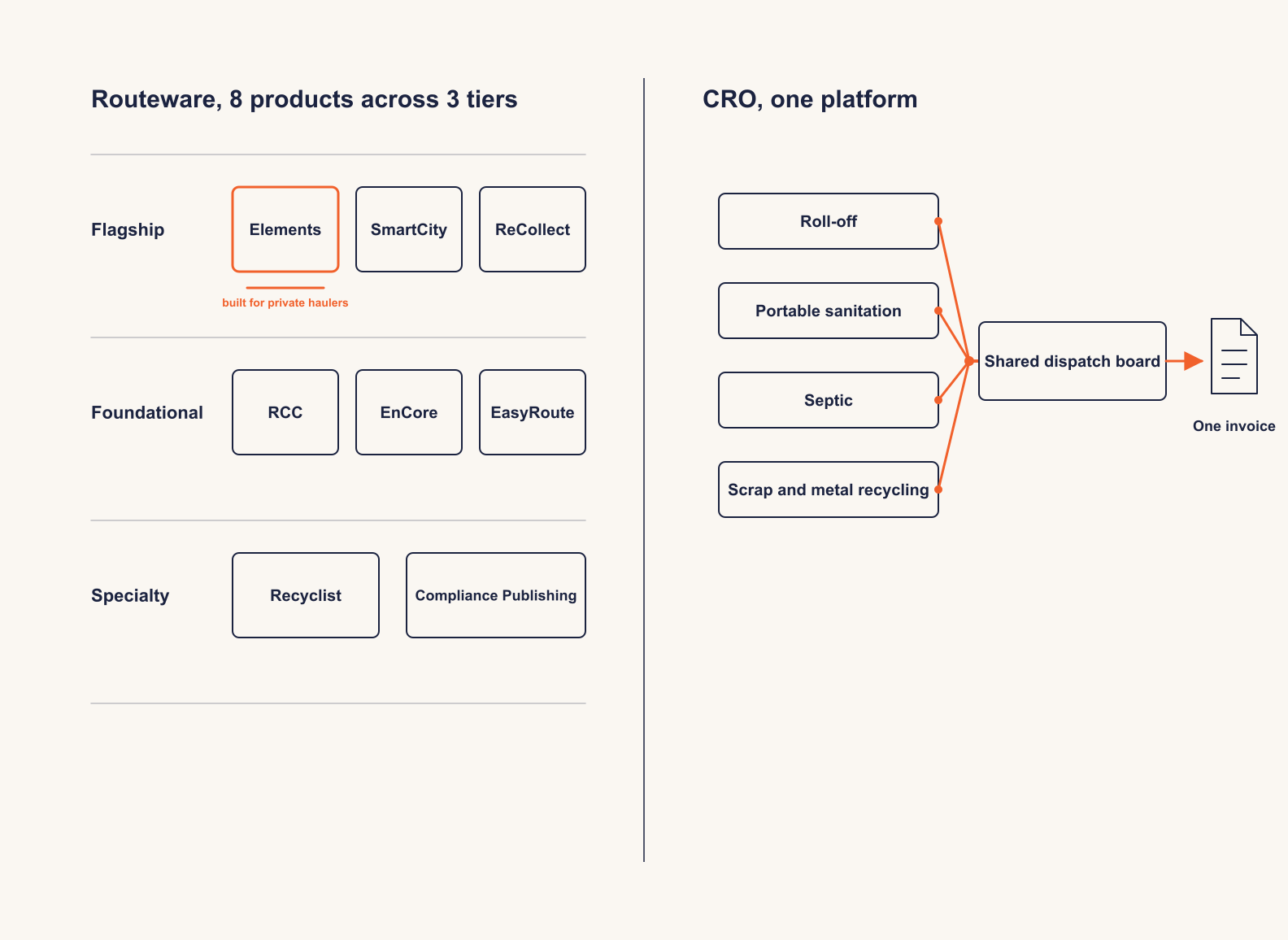
Routeware sells eight named products across three tiers: Elements, SmartCity, and ReCollect as flagship products; RCC, EnCore, and EasyRoute as foundational products; Recyclist and Compliance Publishing as specialty products [5]. Elements is the flagship for private haulers. SmartCity is the parallel flagship built specifically for government customers, and Routeware's own government page names results from named municipalities running its technology [3], including a solid waste director at the City of Concord and a public works director at the City of Kansas City. That is a genuinely different buyer than the private roll-off, portable sanitation, or septic operator CRO is built for. CRO's verticals are built for private, commercial, and industrial service companies, including haulers who run municipal contracts, rather than for a city government's own internal fleet. If municipal RFP requirements, resident-facing compliance reporting, and multi-decade civic procurement are part of the buying process, that is Routeware's home ground, not CRO's.
CRO by RapidWorks customers describe the same pattern: one system instead of several. West Coast Metal Recycling's Terry M. said CRO "was light years ahead of what we were previously using. It has transformed our trucking operation from a clumsy, paper-based system to a cloud-based, immediate response system" [14]. Hoffman Sanitation grew from 3,000 to 13,000 customers on CRO while cutting daily billing time by more than 90 percent [14].
Give both vendors the identical test in a live demo.
Choose Routeware Elements if
If the alternative you are really weighing is a roll-off and dumpster specialist rather than a municipal platform, our CRO against Docket comparison covers that one.
Choose CRO if
See how CRO handles your own routes, assets, and billing. Schedule a demo with one of our roll-off experts today!
Yes. ServiceCore's own blog, cited throughout this article, compares Routeware Elements and CRO Software Solutions directly. That comparison states several things about CRO that CRO's own product page contradicts, which is documented above with both sides cited.
Yes. CRO's Customer Portal lets customers request swaps, services, and pickups, check job status, and pay online, without calling the office.
Yes. Drivers capture photos, notes, and customer signatures on-site, and that record attaches to the job before it can close.
Routeware Elements is built for waste and recycling collection specifically. An operator running portable sanitation, septic, or scrap and metal recycling alongside waste collection would need a second system for those lines; CRO runs all of them in one platform.
Routeware Elements and its sibling government product, SmartCity, are built for that buyer directly, with named municipal customers and government-grade compliance reporting. CRO is built for private commercial and industrial operators, including haulers running municipal contracts, rather than for a government's own internal fleet.
Our CRO against Docket comparison sets it against a roll-off and dumpster specialist instead.
No. Neither vendor lists a price online. CRO quotes a flat monthly base fee plus a per-truck fee after a demo. Routeware Elements is custom-quoted only, reported by two review sites [8][12].