

Concrete Pumping
From boom pumping to telebelts, we help concrete placement teams deliver best-in-class service with every job.
/TEST%20icons/noun-concrete-pump-5976240.svg)
/Industry%20Icons/noun-5917380.svg)
/Industry%20Icons/noun-truck-4140346.png?width=60&name=noun-truck-4140346.png)


/TEST%20icons/noun-crane-truck-6830557.svg)
/TEST%20icons/noun-drilling-5103943.svg)


/Industry%20Icons/noun-road-fence-3990160.png?width=60&name=noun-road-fence-3990160.png)

/No%20Background/noun-maintenance-7409171-F1612C.png?width=60&name=noun-maintenance-7409171-F1612C.png)


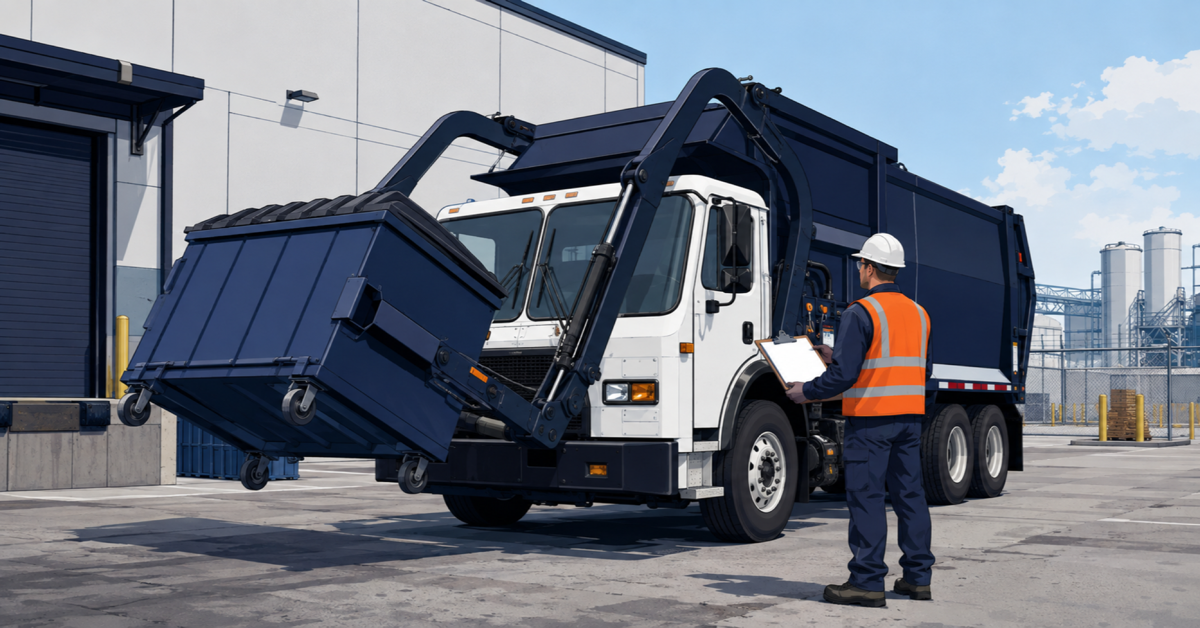
A waste hauler's invoice rarely matches one line item. One customer pays a flat monthly container rent. Another gets billed per-pull, plus a tonnage charge that moves with every load. A third runs on a municipal contract that closes on a calendar the commercial accounts never see. Picking billing software for that is not a feature checklist exercise. It comes down to whether the system understands what actually happened in the field, or whether someone in the office has to translate it by hand every cycle.
This comparison looks at each platform by how it actually bills: recurring container rent, per pull charges, prorated mid-cycle swaps, disposal and tonnage pass-through, surcharges, demurrage, and commercial versus municipal cycles. Every price below comes from the vendor's own current page, checked the same day this article was written.
Quick answer
There is no single best waste management billing software in 2026. It depends on which billing problem you actually have. TrashLab and CRO by RapidWorks build the invoice from field exceptions automatically, which fits an operator running more than one service line. Docket and CurbWaste are built for roll-off and dumpster rental billing, with per unit dynamic pricing. Basestation folds scale ticket weight into the invoice for haulers who bill by tonnage. ServiceCore is built around the 28-day cycle portable sanitation and septic operators bill on, and does not belong on a roll-off shortlist. Service Fusion is generic but has real published pricing. Trash Flow is older, licensed software sold by the module. A single-truck operator on one line can often get by on QuickBooks Online, paired with a tool such as Dispatcher.com.
We looked for solutions that turn what actually happened on a route, dispatch and routing included, into an accurate invoice without a second reconciliation step.
01Recurring and per-pull billing
Whether the platform bills a standing container rent, a one off pull, or both.
02Proration and pass-through costs
What happens to the bill when a container swaps mid-cycle, and whether scale tickets and per ton charges reach the invoice automatically. This one is answered in the FAQ rather than the table, because most vendors describe it in general terms and a yes or no cell would flatten a real difference into a guess.
03Surcharges and exceptions
Fuel and environmental surcharges, extra pickups, and demurrage, and whether a driver can attach them before the job closes.
04Accounting sync and published pricing
Whether QuickBooks is the billing engine or a downstream copy, and whether a real number exists anywhere on the vendor's own site.
| Platform | Built for | Field-exception billing | QuickBooks sync | Published price |
|---|---|---|---|---|
 TrashLab TrashLab | Multi-line haulers | Yes | Yes | No |
 Docket Docket | Dumpster and junk hauling | Dynamic per job | Yes | No |
 CurbWaste CurbWaste | Roll-off, commercial, residential | Recurring templates | Yes | Gated login |
 Basestation Basestation | Multi-vertical, solid and liquid waste | Scale ticket sync | Not named | No |
 CRO CRO | Roll-off, portables, septic, scrap and metal | Yesplus pre-billing | YesOnline and Desktop | No |
 ServiceCore ServiceCore | Portables and septic, not roll-off | 28-day cycle | Yes | No |
| Service Fusion | Generic field service, any trade | No | Yes | Yes$208 to $627/mo |
| Trash Flow | Licensed on-premise software | Yesvariable rate | Via add-on module | Yesby module |
| QuickBooks-anchored | Single truck, single line | Manual only | QuickBooks is the ledger | QuickBooks only |
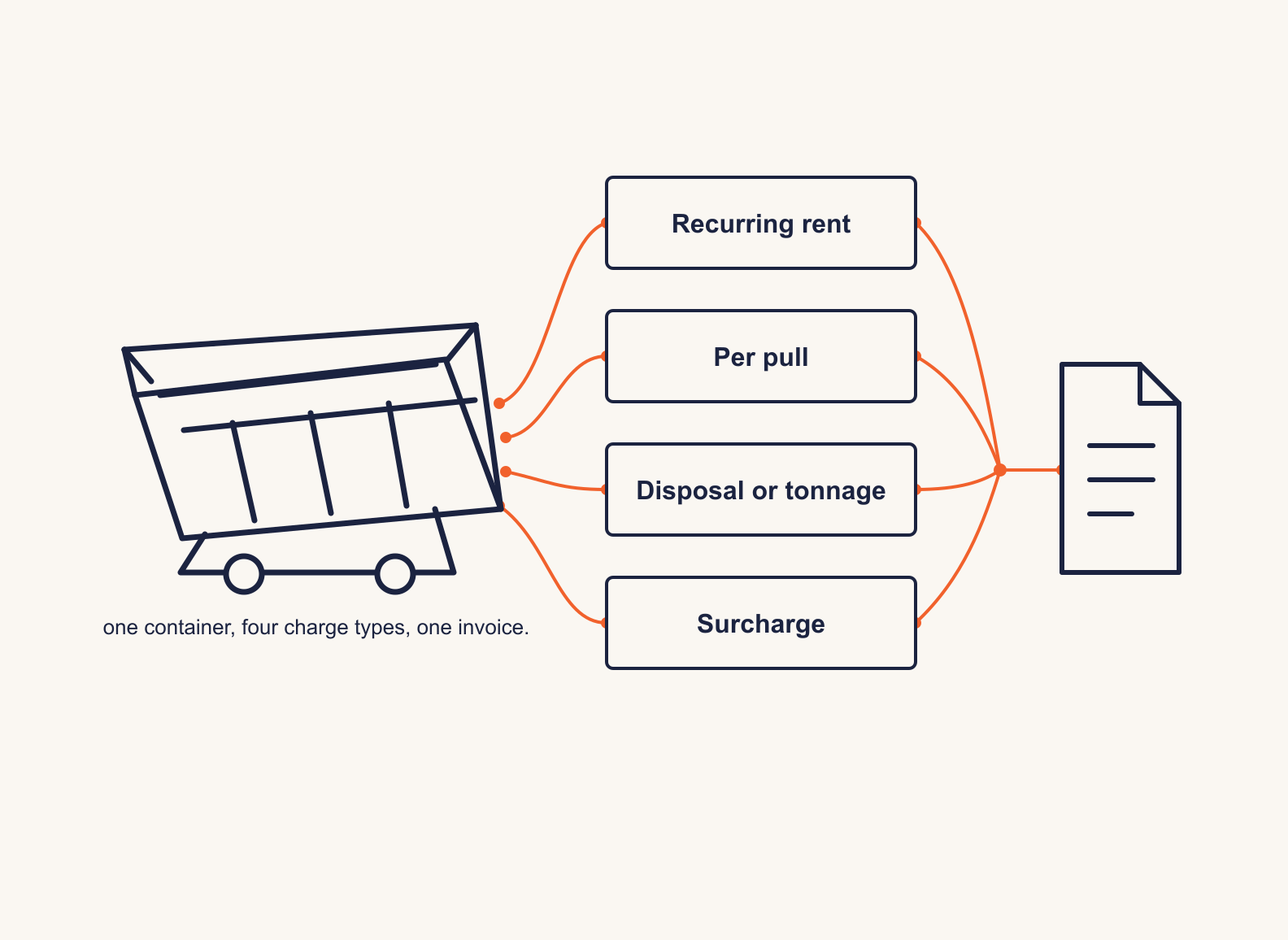
Field service platforms built for plumbers or electricians assume one job equals one invoice line. Waste billing rarely works that way. A container sits on a lot generating rent before it is ever pulled. A pull can trigger a disposal charge unknown until the truck crosses a scale. A service level can change mid-cycle, and a driver can add a fee at the curb that has to land on the same invoice as the standing rent. The platforms below differ in how much of that they automate.
Best for
A multi-line hauler who wants billing built from what the field actually did.
Pricing
Not published. Book a demo.
TrashLab is a cloud billing, dispatch, and CRM platform built for waste haulers. TrashLab's site states that "TrashLab connects dispatch, driver proof, customer accounts, payments, and accounting so haulers can bill faster, defend charges, and reduce manual QuickBooks cleanup" [2]. It will "bill weekly, monthly, quarterly, and custom cycles with service changes, pricing rules, and customer-specific terms applied automatically" [2], and is built to "capture extra pickups, contamination, overages, blocked access, relocation, disposal, and extra rental days from the driver and dispatch workflow" [2]. It also "supports recurring billing cycles for residential, commercial, roll-off, and mixed operations, including account-specific pricing and mid-cycle service changes" [2].
Best for
Dumpster rental and junk removal businesses that price every job on its own specifics.
Pricing
Not published. Processing rates only: 3.0 percent plus 30 cents on Grow, 2.8 percent plus 30 cents on Pro and Pro Plus.
Docket is a dispatch and billing platform for roll-off dumpster rental and junk hauling, sold in Grow, Pro, and Pro Plus tiers. It prices each job dynamically: the billing page says it will "automatically price your dumpsters according to location, materials, weight, rental ran longer than expected, etc" [3], a real answer to prorated, over-length rentals. Invoicing happens at scheduling, and payment runs through the portal, the driver's device, or ACH. Docket does not name disposal or tonnage pass-through as a distinct billing line [4].
Best for
A roll-off heavy operator who wants recurring billing synced straight to QuickBooks with minimal manual entry.
Pricing
Gated behind a login. Not publicly published.
CurbWaste is cloud software built by haulers for roll-off, commercial, and residential waste, with an embedded QuickBooks connection. It states that a hauler can "process all of your invoices and payments directly within the platform" [5], and that "our QuickBooks integration makes accounting seamless, simple, and accurate" [5], with recurring billing templates and automated additional charges so a one-off fee needs no manual line item. Its own pricing page returns an authentication error on a direct fetch [6].
Best for
A multi-vertical hauler who bills by tonnage and wants scale data to land on the invoice without re-entry.
Pricing
Not published. Book a demo.
Basestation is billing, dispatch, and asset-tracking software for commercial front load, roll off and dumpster rental, residential curbside, portable toilets, septic pumping, and dump truck hauling. Its billing page is explicit that "scale ticket data uploads automatically to invoices for easy review" [7], which answers the tonnage and disposal pass-through question for an operator running scale house or landfill weigh-ins. It supports auto-pay but does not name QuickBooks or another accounting sync on that page.
Best for
An operator running more than one waste or site-service line who wants recurring billing, pre-billing, and field-added charges on one record.
Pricing
A flat monthly base fee plus a per-truck fee, quoted after a demo.
CRO was founded by former waste operators in 2013 and joined RapidWorks in 2025. It connects dispatch, field work, billing, and collections for roll-off, with additional support for portable sanitation, septic, and scrap and metal recycling, on one platform. CRO users can set up their customers with their own online booking portal, so they can continue to request services directly online.
On billing, its product page states it will "automatically bill for recurring services and pre-bill before dispatch when required for certain jobs or customers" [1]. Charges added in the field reach the invoice directly: "drivers can add fees, overages, and additional services right at the stop, with those charges flowing directly to the invoice" [1].
Collections run in the same system, where "enhanced collections visibility helps teams follow up on aging accounts quickly, document activity, and get paid faster" [1], and the customer portal offers a "branded portal for swap requests, pickups, online payments, and service history" [1]. QuickBooks stays synced: CRO "keeps customers, products, and invoices aligned with a QuickBooks Online and QuickBooks Desktop integration" [1].
CRO's own case study credits Hoffman Sanitation with growing from 3,000 to 13,000 customers while cutting billing time by more than 90 percent and finishing daily billing in under 30 minutes [1].
Best for
A portable sanitation or septic operator billing on a fixed cycle. Not a roll-off or dumpster shortlist.
Pricing
Not published. Book a demo.
ServiceCore is field service software for portable toilet, septic, grease trap, and dumpster rental businesses. It markets itself around the industry's billing rhythm, telling septic operators they need a system that supports "28-day billing cycles" [8], not a generic tool retrofitted to fit. Its features page states it supports "industry standard billing cycles, customizable rental rates and pricing, and the ability to add surcharges" [9], plus batch invoicing. Its own marketing lists dumpster billing alongside portables and septic, but the product is built around the 28-day cycle those two lines run on, not roll-off.
Best for
A shop that wants a transparent, published monthly price and does not need waste-specific billing logic.
Pricing
Published. Starter runs $208 a month billed annually or $245 month to month, Plus is $325 or $382, and Pro is $533 or $627, with unlimited users on every tier [11].
Service Fusion is a general field service platform used across trades, not built for waste. Service Fusion's site describes billing in generic terms: "field service management software automates billing processes, integrating with billing software such as QuickBooks, saving time and improving accuracy" [10]. Real numbers are the exception here, and Service Fusion is one of only two vendors that publishes them [11]. Nothing on its site names container rent, tonnage pass through, or municipal versus commercial cycles.
Best for
An established hauler who wants licensed, on-premise software rather than a cloud subscription, and is comfortable paying by the module.
Pricing
Published, priced by module. Advanced Billing runs $700, a bundled Base plus Billing plus Advanced Billing package runs $3,050, adding Routing brings it to $3,600, and adding Container Tracking and Routing brings it to $4,150. "SaaS pricing is also available", with no figure published [13].
Trash Flow, from Ivy Computer, is a waste hauler platform sold as licensed Windows software rather than a browser-based subscription, covering billing, routing, and dispatch. It is explicit that "TRASH FLOW products are priced by module" [13], the second vendor on this list with a real published number. Its site describes "variable rate capability for per-unit-of-measure billing" [13], bi-monthly, quarterly, annual, and one-time billing cycles, and a payment add-on it calls "the industry leading waste hauling payment processing system utilized by over 1000 haulers nationwide" [12].
Best for: A single-truck operator on one straightforward line who does not need a dedicated waste billing platform yet. Pricing: QuickBooks Online is published and widely known. The dispatch add-on itself is not.
Not every operator needs dedicated waste billing software. A single line, single-truck operation can run QuickBooks Online as the actual ledger, paired with a lightweight dispatch tool built to push work-order data into it. Dispatcher.com is one example: it states plainly that "our cloud-based software directly integrates with QuickBooks Online so you can reduce the time it takes to bill your customers" [14]. QuickBooks alone has no concept of container rent, disposal pass-through, tonnage, or demurrage, so every waste-specific charge becomes a manual line item, which is exactly the reconciliation work the rest of this list automates.
Don't take a features page at its word. CRO's own case study is specific: Hoffman Sanitation grew from 3,000 to 13,000 customers, cut billing time by more than 90 percent, and now finishes daily billing in under 30 minutes [1]. Ask every vendor for numbers like these directly, in a live demo, rather than trusting the features page alone.
If the decision is about dispatch and container tracking rather than billing, our roll-off software ranking compares the same category on that axis instead.
Choose TrashLab or CRO for more than one service line, with recurring billing, mid-cycle changes, and driver-added charges on one invoice. Choose Docket or CurbWaste if roll-off and dumpster rental is your whole business. Choose Basestation if tonnage and scale-ticket reconciliation is your actual bottleneck. Choose ServiceCore for portables or septic on a 28-day cycle, not roll-off. Choose Service Fusion if a published flat price matters more than waste-specific logic. Choose Trash Flow for licensed software over a cloud subscription. Choose a QuickBooks-anchored setup for one truck on one line.
See how CRO handles your own containers, routes, and billing. Schedule a demo with one of our waste billing experts today!
Only two: Trash Flow, priced by module from $700 to $4,150, and Service Fusion, at $208 to $627 a month depending on tier and billing frequency. Every other platform here, CRO included, quotes a price after a demo.
ServiceCore's own site lists dumpster businesses among the operators it serves, but the platform is built and marketed around the 28-day cycle that portable sanitation and septic companies run on. It belongs on a portables and septic shortlist, not a roll-off one.
Not from marketing pages. Two vendors name the behavior outright: TrashLab describes disposal and rental-day charges as exceptions captured from the driver workflow, and Basestation reconciles scale ticket data straight into the invoice. The rest describe field-captured exception billing in more general terms. Ask every vendor on your shortlist to run one real job in the demo where a disposal or tonnage charge lands on the invoice, and watch what a driver has to do for it to get there. What a page names and what a platform does are different questions.
Our roll-off software ranking compares the same category on dispatch, container tracking and driver work rather than on how each one bills.
QuickBooks Online paired with a lightweight dispatch tool, such as Dispatcher.com, can cover a single-line operation. That setup has no built-in concept of container rent, tonnage, or surcharges, so those still become manual line items.