

Concrete Pumping
From boom pumping to telebelts, we help concrete placement teams deliver best-in-class service with every job.
/TEST%20icons/noun-concrete-pump-5976240.svg)
/Industry%20Icons/noun-5917380.svg)
/Industry%20Icons/noun-truck-4140346.png?width=60&name=noun-truck-4140346.png)


/TEST%20icons/noun-crane-truck-6830557.svg)
/TEST%20icons/noun-drilling-5103943.svg)


/Industry%20Icons/noun-road-fence-3990160.png?width=60&name=noun-road-fence-3990160.png)

/No%20Background/noun-maintenance-7409171-F1612C.png?width=60&name=noun-maintenance-7409171-F1612C.png)


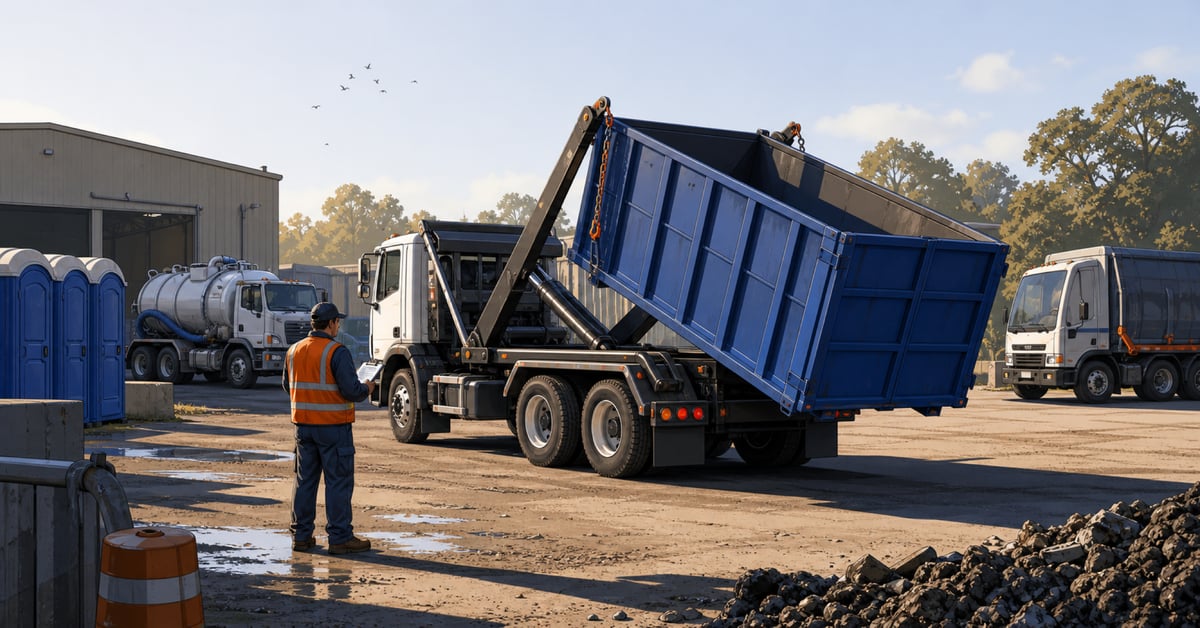
A route can look finished on a dispatch board and still leave the office with three loose ends: which container moved, where the load was dumped, and whether a blocked stop should be rescheduled or billed. That is the difference between managing field-service jobs and managing a waste operation.
Service Fusion is a capable field-service platform. It gives every plan unlimited users, and its current feature set includes scheduling and dispatching, integrated payments, QuickBooks integration, invoicing, reporting, and a technician mobile app. Its public pricing also makes the starting point easier to understand than many quote-only products.
For a plumbing, HVAC, or mixed field-service company, that breadth can be exactly the point. For a waste, dumpster, portable-sanitation, septic, or liquid-waste operator, the buying question is narrower: can the system keep the route, container or unit, disposal event, recurring stop, field exception, and invoice connected without extra work outside the platform?

Current public pricing, verified August 21, 2026: Starter is $245 per month, Plus is $382 per month, and Pro is $627 per month. When billed annually, the published monthly equivalents are $208, $325, and $533. Every plan includes unlimited users. Service Fusion also states that plans are available month to month, with a 15% discount for annual billing.
Those are real strengths. Unlimited users make growth easier to model, while dispatch, payments, QuickBooks, recurring invoicing, and a technician app cover a wide field-service core. A current Service Fusion customer in a multi-service West Texas waste business also told RapidWorks that he was generally pleased with the product and had not experienced issues.
The same operator was exploring waste-specific software because routing looked easier for his operation. That is field insight, not proof of a Service Fusion defect. Use it as an evaluation prompt: ask each vendor to demonstrate a full day from recurring stop through disposal or pump-out, exception handling, container or unit history, and billing.
We ranked these products for multi-service waste and site-service fit, not for every field-service business. The order weighs service-line coverage, route and recurring-stop logic, container or unit records, disposal and pump-out context, field exceptions, billing continuity, mobile execution, and current first-party evidence.
| Option | Best for | Pricing | Waste-operating fit | Service range |
|---|---|---|---|---|
 1. CRO 1. CRO | Multi-service waste and site-service operators | Base platform fee plus per-truck pricing; unlimited office users | Route, container or unit, disposal, exception, billing, and collections records | Roll-off, portable, septic, liquid waste, solid waste, scrap and recycling |
 2. ServiceCore 2. ServiceCore | Portable sanitation and septic teams | Personalized quote; billed monthly with an annual contract | Recurring schedules, route optimization, inventory, pumping records, and billing | Portable sanitation, septic, grease trap, and dumpster businesses |
 3. TrashLab 3. TrashLab | Broad private waste-hauling operations | Contact TrashLab for a quote | Dispatch, routes, inventory, billing, customer communication, and reporting | Roll-off, front-load, rear-load, side-load, portable, septic, and more |
 4. Docket 4. Docket | Dumpster and mixed solid-waste operators | Personalized quote | Online ordering, roll-off task types, route building, container history, and billing | Roll-off, junk removal, commercial trash, and residential trash |
 5. CurbWaste 5. CurbWaste | Roll-off and route operators prioritizing live dispatch | Contact CurbWaste for a quote | Real-time dispatch, serialized inventory, route plans, online ordering, and invoicing | Roll-off, commercial routes, residential routes, and related waste workflows |
Rank 1
Best for
Multi-service waste and site-service operators that want one operating record across routes, containers or units, drivers, billing, and collections.
Pricing
Base platform fee plus per-truck pricing, with unlimited office users and no per-seat fee.
CRO is built around the operating objects a waste company handles every day. A job can carry the container or unit, service activity, route position, driver proof, disposal or pump-out destination, billable additions, and resulting invoice. That makes it the most complete fit here for an operator with more than one waste or site-service division.
The breadth matters when a company runs roll-off dumpsters beside portable restrooms, septic pumping, liquid waste, solid waste, or scrap. Office staff can work in one system without flattening each division into a generic technician appointment.
Where it wins
Where to look closely
Ask the implementation team to map each division, billing rule, route type, disposal destination, and historical data source before you compare screens. A system built for more of the operation deserves a process-level implementation plan.
Verdict: CRO is the best overall Service Fusion alternative in this shortlist for an operator whose complexity comes from multiple waste and site-service workflows, not simply from having more technicians.
Rank 2
Best for
Portable sanitation and septic operators that need recurring schedules, route optimization, inventory, pumping records, and specialized billing.
Pricing
Personalized quote. ServiceCore states that it is billed monthly with an annual contract.
ServiceCore is the clearest specialist alternative for portable restroom and septic work. Its current product pages describe 28-day billing cycles, recurring jobs, route optimization, inventory tracking, QuickBooks compatibility, mobile directions, pumped-volume capture, field charges, and payment collection.
That is a meaningful step beyond a general job record. A portable route and a septic pump-out have recurring-service, inventory, capacity, and billing details that need to survive from scheduling through the office closeout.
Where it wins
Where to look closely
If your company also runs a large solid-waste, scrap, or highly dynamic roll-off division, ask for one demo that spans all service lines. Confirm which workflows live natively in ServiceCore, which run in Docket, and how shared customers, routes, reporting, and billing behave across the product family.
Verdict: ServiceCore is a strong fit for portable sanitation and septic-led operators. It ranks second because those vertical records are well documented, while a broader multi-service operation should verify the cross-division experience in detail.
Rank 3
Best for
Private waste haulers that want dispatch, routing, inventory, billing, customer communication, and reporting across several collection models.
Pricing
No public dollar price was found on the official pages reviewed. Contact TrashLab for a quote.
TrashLab presents one of the broadest waste-service footprints in the shortlist. Its current site covers roll-off, front-load, rear-load, side-load, portable restroom and septic work, along with transportation and landfill operations. The platform connects CRM, dispatch, billing, calls, routes, driver work, and inventory.
The first-party detail is strongest where route changes and inventory movement meet billing. Roll-off pages describe geostamped container photos, yard inventory, automated day and weight billing, and driver location. Portable and septic pages describe route reoptimization, adding new service stops, geotagged units, bulk billing, and a route-focused driver app.
Where it wins
Where to look closely
TrashLab's public site shows considerable breadth, so make the demo specific. Bring one recurring commercial route, one roll-off delivery and pickup, one portable service route, and one exception. Ask the team to show exactly how shared customers, equipment, disposal details, and invoices move across those scenarios.
Verdict: TrashLab is a credible option for a broad private hauler that wants waste-specific operating depth and values a close vendor relationship. It sits behind CRO and ServiceCore because the public evidence is less explicit about septic pump-out records and collections workflows.
Rank 4
Best for
Dumpster rental and mixed solid-waste operators that want online ordering, specialized roll-off tasks, container tracking, route tools, and connected billing.
Pricing
Personalized quote. Docket asks buyers to schedule a demo for pricing tailored to the business.
Docket goes much further than a generic field-service schedule for dumpster work. Its current roll-off pages cover online ordering, zip-code pricing, deliveries, pickups, exchanges, relocations, dump and returns, live loads, driver directions, site photos, container scans, weight and material records, disposal location, yard check-in, and dumpster aging.
Docket also now presents a mixed solid-waste workflow for commercial trash, residential trash, and roll-off. That product view brings scheduled routes, service frequency, stop completion, driver-reported exceptions, carts, and roll-off work onto one dispatch surface.
Where it wins
Where to look closely
Docket is strongest where dumpsters and solid-waste routes drive the operation. Portable sanitation and septic teams should ask for direct demonstrations of unit servicing, 28-day cycles, pump volumes, pump-out destinations, and any division-level reporting they require.
Verdict: Docket is a strong Service Fusion alternative for roll-off and mixed solid-waste operations. It ranks fourth only because the article's audience includes portable sanitation, septic, and liquid-waste operators as well.
Rank 5
Best for
Roll-off, commercial, and residential route operators that prioritize real-time dispatch, serialized inventory, customer updates, online ordering, and integrated billing.
Pricing
No public dollar price was found on the official pages reviewed. Contact CurbWaste for a quote.
CurbWaste is built around waste hauling rather than general technician scheduling. Its current product pages describe map, list, and visual dispatch views, real-time driver updates, automated customer texts, iOS and Android driver apps, QuickBooks integration, customer portals, online ordering, route planning, serialized inventory, and automated rental-day fees.
The inventory detail is especially relevant to roll-off. Drivers update serialized equipment from the app, while dispatch can see location, time on site, future orders, and projected availability. Route pages also describe live edits and an audit trail showing who changed a route and when.
Where it wins
Where to look closely
For a company with portable sanitation, septic, or liquid-waste divisions, ask CurbWaste to demonstrate unit service histories, recurring cycle changes, pump volumes, disposal destinations, compliance fields, and cross-division reporting. The public evidence reviewed is strongest for roll-off and solid-waste routing.
Verdict: CurbWaste is a serious waste-specific option for live dispatch, route management, and roll-off inventory. It ranks fifth for this multi-service brief because its current first-party detail is less specific to portable sanitation and liquid-waste records.
01
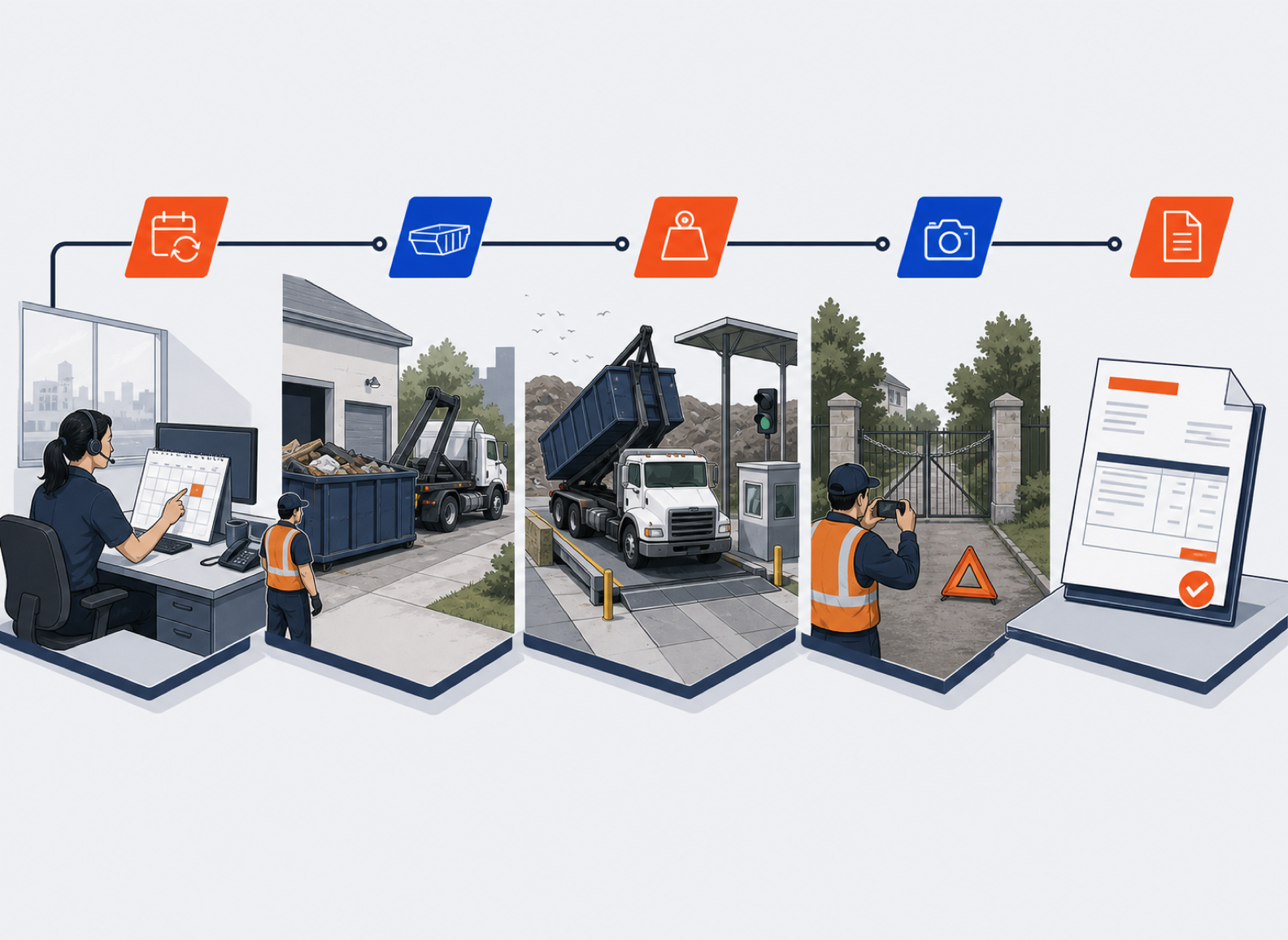
Ask the vendor to build a permanent route, insert an emergency service, move work after a truck issue, and show what the driver sees. A route map alone is not enough.
02
Deliver it, service it, move it, fail a stop, return it to the yard, and inspect its time on site. The office should not have to reconstruct that history from job notes.
03
Use a real scenario with weight, material, gallons, capacity, fees, or destination. Confirm which details follow the job into billing and reporting.
04
Require a photo and note, return the exception to dispatch, reschedule it, and apply the right charge. This is where informal phone-and-text processes usually reappear.
05
Add an overage or extra service in the field, complete the work, and verify the invoice and accounting sync. Nobody should key the same event twice.
06
Compare data cleanup, route setup, customer and asset history, integrations, training, driver adoption, support, and the first billing cycle after go-live.
Do not replace Service Fusion simply because another vendor uses the word waste. Replace it only when a better operating model removes work your team is doing between systems, in spreadsheets, or over the phone.
For a multi-service operation, CRO is the strongest first demo because it covers the broadest combination of waste and site-service records in one product. ServiceCore should be high on the list for portable sanitation and septic. TrashLab brings broad hauler coverage. Docket is compelling for dumpsters and mixed solid waste. CurbWaste is strong in live dispatch, routes, and roll-off inventory.
Bring the same six scenarios to every demo. The best alternative is the one that preserves the operating truth from the first recurring stop to the final invoice.
CRO is the strongest overall fit in this shortlist for an operator combining roll-off, portable sanitation, septic or liquid waste, solid waste, or scrap and recycling. It connects route, container or unit, driver, disposal, billing, and collections records in one waste-specific product.
No. Service Fusion offers unlimited users, dispatch, payments, QuickBooks integration, invoicing, and a technician app, and some waste operators use it successfully. The question is whether your routes, containers or units, disposal events, recurring stops, and exceptions require waste-specific records or too much work outside the system.
As verified on August 21, 2026, Service Fusion lists Starter at $245 per month, Plus at $382 per month, and Pro at $627 per month. The published monthly equivalents for annual billing are $208, $325, and $533. Every plan includes unlimited users.
ServiceCore is a strong specialist option because its current product pages document portable-sanitation billing cycles, recurring schedules, route optimization, inventory, septic pump records, mobile field charges, and QuickBooks compatibility. CRO is the stronger first look when those divisions must share one system with roll-off, solid waste, or scrap.
CRO, TrashLab, Docket, and CurbWaste all publish roll-off-specific capabilities. Docket documents detailed dumpster task types and online ordering, CurbWaste emphasizes live dispatch and serialized inventory, TrashLab connects roll-off dispatch and billing, and CRO combines roll-off with other waste and site-service divisions.
Ask every vendor to run the same six scenarios: a recurring route, a day-of change, a container or unit move, a disposal or pump-out record, a blocked or failed stop, and an invoice built from field activity. Then compare data migration, training, driver adoption, accounting sync, support, and the first billing cycle after go-live.
Methodology
This editorial shortlist was reviewed against current first-party vendor pages and sitemaps on August 21, 2026. The order reflects fit for multi-service waste, dumpster, portable-sanitation, septic, and liquid-waste operations. It is not a universal ranking for every field-service business. Private buyer evidence was used only as anonymous field insight and evaluation guidance.