

Concrete Pumping
From boom pumping to telebelts, we help concrete placement teams deliver best-in-class service with every job.
/TEST%20icons/noun-concrete-pump-5976240.svg)
/Industry%20Icons/noun-5917380.svg)
/Industry%20Icons/noun-truck-4140346.png?width=60&name=noun-truck-4140346.png)


/TEST%20icons/noun-crane-truck-6830557.svg)
/TEST%20icons/noun-drilling-5103943.svg)


/Industry%20Icons/noun-road-fence-3990160.png?width=60&name=noun-road-fence-3990160.png)

/No%20Background/noun-maintenance-7409171-F1612C.png?width=60&name=noun-maintenance-7409171-F1612C.png)



Quick answer
Scrap metal ERP is the connected operating system a recycler uses to manage material, money, equipment, people, and customer work. In practice, it may combine a yard-side system for seller records, scale tickets, grades, purchasing, inventory, and outbound shipments with a hauling-side system for customer sites, containers, dispatch, drivers, service proof, and billing. The accounting platform remains the financial system of record. CRO can support the hauling and container-operations layer, while the yard and accounting systems retain their defined records. A successful implementation defines which system owns each record before data is migrated or integrations are built.
A scrap operation can receive material across a scale, dispatch a roll-off to a customer, process inventory, ship a finished commodity, and close the financial day. Those activities are connected, but they do not all create the same kind of record.
That distinction is the starting point for understanding scrap metal ERP. A category explainer should not collapse a purchase ticket, a hauling job, and a general-ledger entry into one generic transaction. Each has a different owner, approval path, and audit purpose.
ERP stands for enterprise resource planning. In scrap and recycling, the useful definition is broader than accounting and narrower than "every piece of software in the company." It is the operating architecture that connects core workflows and gives each important record an authoritative home.
For a recycler, that architecture commonly includes five layers:
| Layer | Primary record | Starts with | Ends with |
|---|---|---|---|
| Yard operations | Material transaction | Seller or supplier and inbound load | Purchase ticket, inventory update, or outbound shipment |
| Hauling operations | Service job | Customer request, scheduled work, or recurring service | Completed job with container and service evidence |
| Accounting | Financial transaction | Approved purchase, sale, invoice, payment, or adjustment | Posted entry, reconciliation, and financial reporting |
| Equipment and maintenance | Asset record | Truck, trailer, container, scale, or processing equipment | Availability, inspection, maintenance, and lifecycle history |
| Reporting and controls | Exception or management view | Data from operating and financial systems | Reviewed exception, decision, and accountable follow-up |
A small operator may run several of these layers in one product. A larger or more specialized recycler may use separate systems connected by integrations. The right test is not whether the company has one login. It is whether every critical record has one clear owner and moves through a controlled workflow.
The yard-side system begins when material arrives. Its job is to turn a physical load into a traceable purchase, inventory movement, or shipment.
The first record is the party delivering or selling material. Depending on the transaction and jurisdiction, the yard may need identity, vehicle, payment, photograph, signature, hold-period, or reporting information. Requirements vary by state and locality, so configuration should follow the yard's legal review rather than a generic national template.
The system should prevent a clerk from bypassing required fields simply to move the line faster. It should also retain the original evidence and the person who captured or changed it.
A scale transaction usually needs more than gross, tare, and net weight. A controlled ticket can include:
NIST Handbook 44 is the current federal model standard for weighing and measuring devices, while states decide how those requirements are adopted and enforced. Software does not make a scale legal for trade. It should preserve the data and controls needed to support the yard's approved weighing process.
The yard must connect the measured load to the commercial decision. That means recording the commodity or grade, applied price, deductions, purchase total, and any approval required for an override.
A price table can speed up routine purchasing, but it should not remove accountability. The system should show which price was active, who changed it, when the change took effect, and why a ticket departed from the normal rule.
Once purchased, material becomes inventory or moves into a processing stream. The yard-side record should support the level of traceability the business actually manages, such as commodity, grade, location, package, heat, bundle, or weight pool.
Outbound sales then reduce that inventory and connect shipment details to the customer order, bill of lading, scale records, and invoice. The goal is not a false promise of perfect physical precision. It is a repeatable reconciliation between what the yard bought, processed, held, sold, and shipped.
Hauling begins with a service commitment outside the scale house. The primary record is a job tied to a customer, site, asset, truck, driver, schedule, and proof of work.
This is a different operating domain from scrap purchasing.
A hauling record should separate the billing customer from the service location. Each site may have access instructions, service windows, contacts, material restrictions, container placement notes, and agreed charges.
Recurring work should be structured as a schedule, not hidden in a notes field. One-time deliveries, swaps, pulls, relocations, and returns should remain distinct job types so dispatch, drivers, and billing interpret them the same way.
A container is both a physical asset and part of a service promise. Its history should show:
The important control is event history. Editing the current location must not erase how the container got there.
Dispatch turns scheduled work into a day plan. It assigns the job, truck, driver, container, and sequence, then records changes as conditions shift.
Routing can help sequence work, but the dispatcher still needs to account for container availability, truck type, yard and customer hours, disposal or processing destinations, traffic, driver availability, and urgent changes. Where federal hours-of-service or electronic logging rules apply, the ERP or dispatch plan does not replace the carrier's compliance process.
The driver app should return structured evidence: arrived, delivered, swapped, picked up, failed, photographed, signed, and completed. A completed job can then support billing without requiring office staff to reconstruct the day from calls and paper tickets.
CRO fits at the hauling and container-operations layer. It can connect customer sites, container and per-unit records, dispatch, driver proof of service, completed work, field-to-invoice billing, and the approved handoff to QuickBooks.
CRO is not the yard-side ERP, certified scale system, material inventory ledger, or general ledger. A recycler still needs those systems to own weighing, grading, purchasing, material value, inventory, posting, tax, and financial reporting where applicable.
The architecture decision is therefore about ownership and reconciliation. Define which system owns the customer, container, job, scale ticket, material transaction, invoice, and accounting entry, then test the handoffs and exception queues between the yard, hauling, and accounting systems.
Consider a customer who requests a container, fills it with material, and schedules pickup.
No system should silently invent the record owned by another. An integration should carry a stable identifier so staff can trace the accounting entry back to the job or ticket that created it.
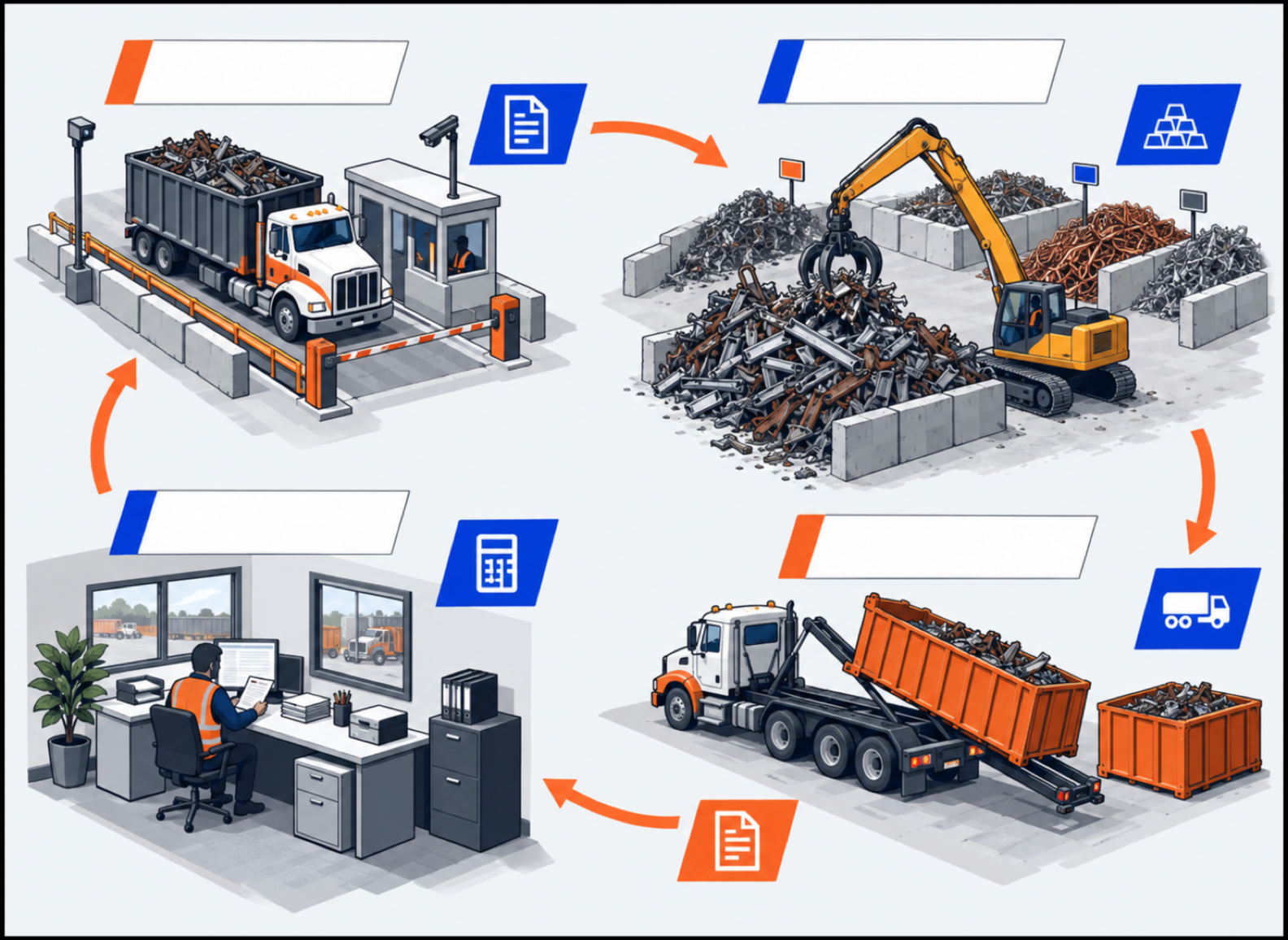
Accounting integration is not complete when a file exports successfully. The design should answer who can create, approve, transfer, change, and reconcile each transaction.
Useful controls include:
The accounting platform should remain the authority for the chart of accounts, posting, tax treatment, period close, and financial statements. The yard and hauling systems should retain the operational detail that explains why each approved financial transaction exists.
Implementation is a business-process project with software inside it. Microsoft Dynamics 365 implementation guidance is product-specific, but its core disciplines apply broadly: data governance, test strategy, user acceptance, cutover planning, training, security, support, and migration readiness.
Document what actually happens, including workarounds. Follow representative transactions from request or arrival through approval, billing or settlement, accounting, and reconciliation.
Include exceptions such as a broken scale, rejected load, changed grade, price override, container at the wrong site, failed pickup, duplicate customer, offline driver, returned payment, and disputed ticket.
Create a data-ownership matrix before configuring integrations. Decide which system owns customers, sites, sellers, suppliers, commodities, grades, prices, trucks, containers, jobs, scale tickets, inventory, invoices, payments, and the general ledger.
Also decide which fields may be copied and which may be edited only in the source system.
Normalize customer and supplier names, addresses, tax settings, material codes, container IDs, truck IDs, chart-of-accounts mappings, and open balances. Merge duplicates deliberately. Do not migrate every old note simply because it exists.
Use data stewards from the yard, dispatch, accounting, and management teams. The people who understand the records should decide what is accurate, active, and required.
For each interface, define direction, timing, identifiers, required fields, validation, retry behavior, duplicate handling, and ownership of failures.
A successful transfer is only one path. The design also needs a visible queue for rejected records, changed records, partial failures, and corrections.
Migrate a representative copy of customers, suppliers, materials, assets, open jobs, open tickets, open receivables, and opening balances. Reconcile record counts and financial totals. Then let users run real scenarios against the converted data.
Repeat the process until the team can predict duration, validate results, and resolve failures within the cutover window.
A useful pilot is not a demo with perfect sample data. Choose one yard, scale lane, commodity family, customer group, dispatch team, or route set. Process work from the first operational event through accounting reconciliation.
Measure exceptions, not only speed. The pilot should reveal missing permissions, unclear ownership, duplicate records, weak training, and integrations that fail under normal changes.
The cutover plan should name the final data freeze, last legacy transactions, migration sequence, validation owners, go or no-go criteria, communication plan, support coverage, and fallback decision.
Do not shut down the old process until required balances, open work, asset locations, and critical integrations are reconciled.
For the first days and weeks, review source-to-accounting totals, unprocessed exceptions, missing container events, scale ticket sequences, overrides, inventory variances, and user access. Assign every exception to an owner and track it to closure.
A single-location yard with limited hauling may prioritize fast ticketing, compliant seller records, basic inventory, accounting handoff, and a simple dispatch board.
A multi-yard recycler needs consistent material definitions, controlled location-specific prices, intercompany or inter-branch processes, centralized customer and supplier governance, cross-yard inventory visibility, and consolidated reporting.
A hauling-heavy scrap operator needs stronger customer-site records, container event history, route planning, driver proof, telematics context, and job-to-invoice controls. It may still depend on a separate yard platform for scale and commodity accounting.
A regional or enterprise recycler may add formal master data management, integration monitoring, role-based security, data warehouse reporting, disaster recovery, and phased releases. More scale creates more reasons to separate system ownership, not fewer.
Next step
Bring one real inbound load, one container movement, and one accounting handoff to a system review. Schedule a demo with one of our scrap and recycling experts today!
Scrap metal ERP is the connected operating architecture used to manage yard transactions, material inventory, hauling work, assets, accounting handoffs, and management controls. It may be one platform or several integrated systems.
Not always. Scrap yard software usually focuses on seller records, scale tickets, purchasing, compliance, inventory, and outbound sales. Scrap metal ERP can include that yard system plus hauling, maintenance, accounting, integrations, and reporting.
Yard-side software owns material transactions such as weighing, grading, purchasing, inventory, and shipping. Hauling-side software owns service work such as customer sites, containers, dispatch, routes, driver activity, proof of service, and job billing.
No. A hauling platform can schedule a pickup and preserve job evidence, but legal-for-trade weighing depends on approved scale equipment, adopted measurement rules, operating procedures, and the yard-side ticket record.
Start with governed master data: active customers, suppliers, sites, materials, grades, prices, containers, trucks, users, and accounting mappings. Then migrate the open transactions and balances required to operate and reconcile at cutover.
Send approved operational transactions with stable source identifiers, validation, duplicate controls, and an exception queue. Keep posting, tax, period close, and financial statements in the accounting system, while the operational systems retain the detail behind each transaction.