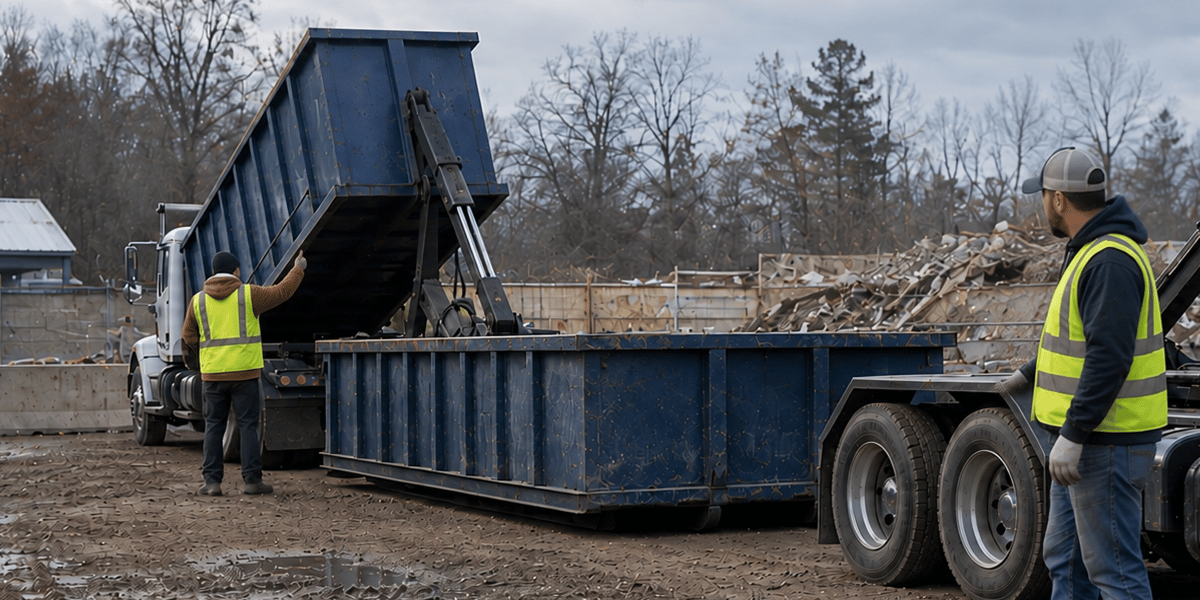
Still on a just good enough software? Here's What Operators Are Switching For
You didn't pick your current software because it was wrong for you. You picked it because it was available, it was cheaper than doing nothing, and it did the basics — scheduling, some invoicing, maybe a driver app. For a while, that was enough.
But if you're a roll-off operator, you've probably noticed the same thing a lot of owners notice a year or two in: the software doesn't actually know what a container is. It treats a swap like any other "job," a dry run like any other cancellation, and an idle can sitting on a customer's lot for six weeks like it doesn't exist at all. You've built workarounds — a side spreadsheet, a driver group chat, a mental list of "cans I haven't seen in a while." It works. It's just also quietly costing you money.
Why "It Basically Works" Is Still Costing You
Generic field service platforms were built for trades where the job is the asset — a plumber shows up, fixes something, leaves. There's nothing to track once the truck pulls away. Roll-off doesn't work that way. Your containers are out in the field for days or weeks at a time, generating revenue only while they're actively deployed and doing nothing but costing you yard space and depreciation the rest of the time.
When your dispatch software has no real concept of an asset — no way to see how long a can has been sitting, no way to flag it as overdue for a swap — that visibility gap becomes a habit. Dispatchers start managing containers from memory and side notes instead of the system. Drivers write "left can at customer" in a free-text field that nobody reads until a customer calls asking where their dumpster went. Billing admins invoice off what they can piece together instead of what actually happened on-site, which means driver add-ons — a blocked access fee, an extra day, a second pickup — get missed more often than anyone wants to admit.
None of this shows up as a single big failure. It shows up as a slow leak: a few unbilled fees a month, a few containers that sit two weeks longer than they should, a dispatcher who spends an hour a day just confirming things the software should already know.
The Patchwork Trap
Most operators don't stay stuck with software that doesn't fit — they work around it. And the workaround usually looks the same: bolt on another tool for whatever the main system doesn't do. No real asset tracking, so someone builds a tracking spreadsheet. Invoicing doesn't sync cleanly, so billing keeps a manual log to double-check what actually went out. Collections falls through the cracks, so someone's chasing overdue accounts through email instead of a real workflow.
Each fix solves one problem on its own. The trouble is what happens once you've made three or four of them. Now you're not running one system — you're running a system plus a spreadsheet plus a side tool plus someone's personal process for catching what falls through. Nothing talks to anything else, so every add-on creates a new place for information to get lost. The dispatcher checks one thing, the spreadsheet says another, and billing finds out about a driver's add-on charge two weeks after the invoice already went out.
This is usually where the real cost of "good enough" software shows up — not in the original tool, but in everything you had to build around it just to make it usable.
Why Roll-Off Operators Stick With Software That Doesn't Fit
None of this makes an operator feel foolish for staying put — the honest reason most roll-off businesses haven't switched isn't that the problem is invisible; it's that switching software feels like a bigger disruption than living with the workarounds. You've already got your customers loaded, your team trained on the workflow (however clunky), and no guarantee that another generic platform would be any better suited to containers than the one you've got.
That hesitation makes sense if the alternative is "another general-purpose tool." It makes a lot less sense once you know there's software built specifically around container-based operations rather than adapted from a plumbing or HVAC scheduling tool.
What Purpose-Built Roll-Off Dispatch Actually Looks Like
Picture a system where a container isn't a side note — it's a tracked asset from the moment it's deployed. Dispatchers can see every can, portable, or unit in the field, how long it's been at a given site, and which ones need to move, without running a mental checklist or texting a driver to check.
Dispatch itself is visual and fast: jobs get assigned by dragging them onto a route, and drivers see their assignments update in real time on a mobile device — no printed sheets, no calling in for the day's list. When a driver finishes a job, they document it on the spot: photos, a signature, and any add-on charges entered right there in the field. That job closing out is also the moment billing gets accurate, because the invoice builds itself from what the driver actually recorded — not from what the office assumes happened.
That's the shift: instead of dispatch, tracking, and billing living in three disconnected places (a scheduling tool, a spreadsheet, and someone's memory), they're one continuous flow. The dispatcher isn't managing containers by hunch. The billing admin isn't chasing down what really happened on-site. And nothing sits idle long enough to become a write-off.
How CRO Closes the Gaps Generic Software Leaves Open
This is where CRO is built differently, on purpose. It treats containers as first-class assets rather than an afterthought bolted onto generic job scheduling — so dispatchers get a live view of every container's location and how long it's been deployed, drivers get a mobile app that captures proof of service and lets them add charges from the job site, and completed jobs turn into invoices automatically, including whatever the driver added, synced straight to QuickBooks.
Operators who've made the switch notice it in how much friction disappears from daily work. As Nanci at MST Dumpsters put it, "What we get out of CRO is fantastic! The dispatching is easy, the customer entry system is easy, the invoicing is easy. We find that the whole system is very user friendly." That's the difference between software that was adapted to fit roll-off and software that was built around it from the start.
CRO now supports 700+ companies across roll-off, portable sanitation, septic, and scrap operations, handling more than 11 million jobs and $2.2 billion in invoicing a year — which means the workflows built into it are shaped by roll-off operators' actual day-to-day, not retrofitted from a different trade.
The Cost of Waiting Is Still a Cost
Every month you stay on software that wasn't built for containers is another month of small leaks — a few unbilled fees, a container sitting longer than it should, a dispatcher doing manual work the system should be doing for them. None of that shows up as a crisis. It just quietly adds up.
If you want to see what roll-off dispatch looks like when the software actually understands containers, book a discovery call with someone who's worked with operators making this exact switch. No pressure to commit — just a chance to see whether it fits how you actually run your business.
FAQs
What's the difference between roll-off dispatch software and generic field service software?
Roll-off dispatch software tracks containers as ongoing assets — location, deployment time, swap status — while generic field service software is built around one-time jobs and has no concept of equipment sitting in the field for days or weeks. That gap shows up as idle containers, missed add-on billing, and dispatchers managing assets from memory instead of the system.
How do I know if my roll-off business has outgrown generic software?
The clearest signs are containers you can't account for without checking a side spreadsheet or calling a driver, invoices that miss fees drivers added on-site, and a dispatcher who spends real time each day confirming things the software should already track. If any of those sound familiar, the software is likely the bottleneck, not your team.
What should roll-off operators look for when switching dispatch software?
Look for software that treats containers as trackable assets, connects driver activity in the field directly to invoicing, and syncs with your existing accounting system rather than requiring manual re-entry. Purpose-built platforms for roll-off, like CRO, are designed around these workflows rather than adapting a generic scheduling tool to fit them.
Does switching dispatch software mean starting over with QuickBooks?
No — CRO syncs with both QuickBooks Online and QuickBooks Desktop, so your customers, products, and invoices stay aligned without manual re-entry during or after the switch.

/TEST%20icons/noun-concrete-pump-5976240.svg)
/Industry%20Icons/noun-5917380.svg)
/Industry%20Icons/noun-truck-4140346.png?width=60&name=noun-truck-4140346.png)


/TEST%20icons/noun-crane-truck-6830557.svg)
/TEST%20icons/noun-drilling-5103943.svg)


/Industry%20Icons/noun-road-fence-3990160.png?width=60&name=noun-road-fence-3990160.png)

/No%20Background/noun-maintenance-7409171-F1612C.png?width=60&name=noun-maintenance-7409171-F1612C.png)