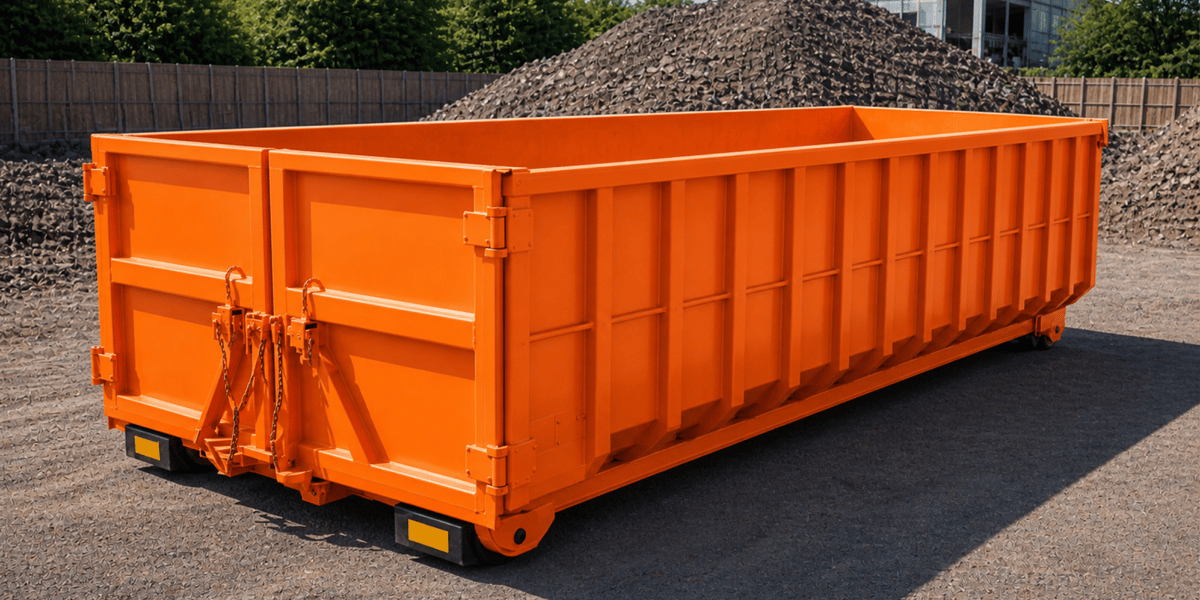
Somewhere on a customer's lot right now, one of your containers is sitting empty. It's been there for three weeks. Maybe longer. Nobody called about it, so nobody thought about it — until you ran a report, or worse, until a customer called asking why they're still being charged for a container they thought was picked up weeks ago.
That container isn't working for you. It's not generating revenue, and it's not available for the next job that needs it. It's just sitting there, quietly costing you money every day it stays put.
Why an Idle Container Is Quietly Draining Your Revenue
Container idle time is the gap between when a unit finishes earning revenue at one job and when it starts earning revenue at the next. Every day in that gap is a day the container isn't working — but it's still costing you in yard space, depreciation, and opportunity.
Here's the math most operators don't run until it's too late: if a 20-yard container earns you roughly $40 a day in placement revenue and it sits idle for 30 days between jobs instead of 5, you've lost 25 days of revenue on that single unit — around $1,000. Now multiply that across a fleet of 150 containers, and even a modest chunk sitting idle longer than it should adds up to tens of thousands of dollars a year in revenue you never collected, on assets you already own.
It's not just the direct revenue loss. Idle containers reduce your effective fleet size — you end up buying more containers to cover demand you could've met with the ones already deployed, sitting unused on a customer's lot. Idle assets also compress route density. A driver running a route full of stops where the "job" is really just confirming a container is still there isn't running a productive route. And when a customer disputes a rental period because nobody can say for certain how long the container was actually on-site, that's a billing fight you didn't need to have — and sometimes a customer relationship that takes the hit.
Why Most Operators Don't Catch Idle Containers Until It's Too Late
Most roll-off operators know idle containers are a problem. Very few have a reliable way to see it happening in real time. Container tracking usually lives in a dispatcher's memory, a driver's notes, or a spreadsheet that only gets updated when someone remembers to. Generic dispatch or field service software wasn't built with asset-level tracking as a core function — it's built around jobs and technicians, not physical inventory sitting on customer sites for weeks at a time.
So operators patch the gap. They run manual "oldest asset" checks when they have time, or they wait for a customer to call. It's not that the problem isn't recognized — it's that the tools available either don't track containers as assets at all, or they weren't designed for a business where the asset itself is half the operation.
What It Looks Like When You Always Know Where Every Container Is
Picture a system where every container has a status the moment it's dropped: location, customer, and days on-site, updated automatically as drivers complete their routes. Instead of finding out a container has been idle for six weeks when a customer calls to complain, you're the one who notices first — because you can run a report and see every asset sitting past its expected pickup window, sorted by how much revenue it's costing you.
In this world, dispatchers aren't guessing about what's deployed where. Route planning accounts for real container locations instead of assumptions. Drivers plot exact placement on arrival, so nobody's driving to a lot squinting at three possible spots where a container "might" be. When something sits too long, it surfaces on its own — you don't have to go looking for it. And when a customer calls asking about their container, the answer is a lookup, not a phone tree.
That's the shift: from reactive ("we'll deal with it when someone notices") to proactive ("we know before it becomes a problem"). It's the difference between managing containers by memory and managing them by data.
How CRO Turns Container Visibility Into Recovered Revenue
This is exactly what CRO's asset tracking is built to do for roll-off operators. Every container is tracked in real time, showing where it's deployed and how long it's been there — so instead of discovering an idle asset by accident, you can pull a report and see your oldest containers sitting across every customer site, ranked by days idle.
Visual asset plotting means drivers pin the exact location of a container when it's dropped, so there's no ambiguity when it's time to retrieve it or when a customer calls asking where theirs is. Because that data updates the moment a job closes, your dispatch board reflects reality — not a guess based on when a route was last run.
That visibility feeds directly into route density, too. When you know exactly which containers have been sitting the longest, you can proactively call customers to schedule a swap or pickup instead of waiting for them to call you — turning a dead asset back into a working one and filling out a route that would otherwise have unnecessary mileage.
Ryan at ACME Roll-Off put it plainly: "Before CRO, we were losing cans and that's not going to fly. If an asset sits for months, that's money lost. Now I can run a report to see where my oldest cans are." That's the entire idle-time problem in one sentence — and the fix isn't more headcount or more phone calls, it's visibility into assets you already own.
Turning Idle Containers Back Into Working Revenue
Every idle container is revenue sitting on a lot, doing nothing. The fix isn't complicated — you just need to see it happening before your customer does. If you want to see how CRO's asset tracking would work with your fleet size and route structure, we can walk you through it on a quick call. Book a discovery call today to chat with one of our experts!
FAQS
What is container idle time in a roll-off business?
Container idle time is the period a roll-off container sits at a customer site, in a yard, or in storage without generating placement revenue — typically the gap between the end of one billable placement and the start of the next.
How do you calculate revenue lost to idle containers?
Multiply your average daily placement rate by the number of idle days beyond your target turnaround, then multiply by the number of containers affected. A 30-day idle period versus a 5-day target on a $40/day container represents roughly $1,000 in lost revenue per unit.
What causes container idle time?
Most idle time comes from a lack of real-time visibility — dispatchers and owners don't know a container is sitting until a customer calls or someone manually checks. Manual tracking methods like spreadsheets or memory-based dispatch make this worse as fleet size grows.
How does container tracking software reduce idle time?
Software that tracks container location and days-on-site automatically surfaces idle assets before they become a billing dispute or a lost revenue opportunity, letting operators proactively schedule swaps or pickups instead of reacting to customer calls.



/TEST%20icons/noun-concrete-pump-5976240.svg)
/Industry%20Icons/noun-5917380.svg)
/Industry%20Icons/noun-truck-4140346.png?width=60&name=noun-truck-4140346.png)


/TEST%20icons/noun-crane-truck-6830557.svg)
/TEST%20icons/noun-drilling-5103943.svg)


/Industry%20Icons/noun-road-fence-3990160.png?width=60&name=noun-road-fence-3990160.png)

/No%20Background/noun-maintenance-7409171-F1612C.png?width=60&name=noun-maintenance-7409171-F1612C.png)