You've been thinking about switching to a purpose-built portable sanitation route software for a while now. Maybe you've sat through a demo. Maybe you've compared a few options. You can see how it would clean up your billing, keep better track of your assets, and finally get your routes organized without a whiteboard and three text message threads.
But there's a version of this that keeps you up at night.
Your drivers.
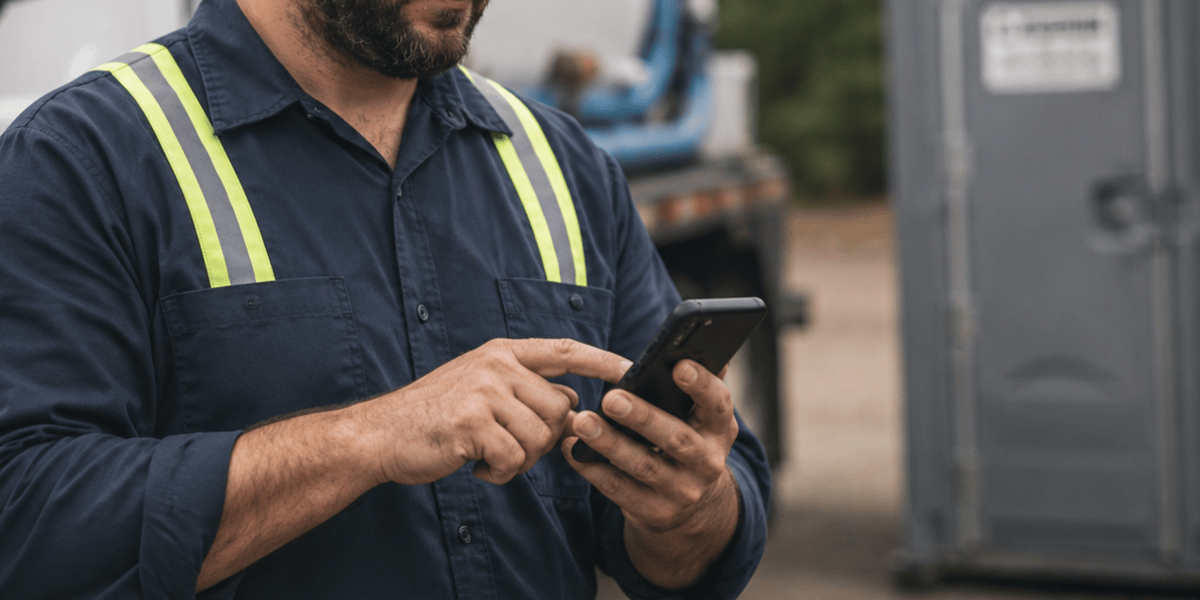
You know what your team is like. High turnover. Long days in the truck. Not exactly eager to learn a new app when they've got 30 units to service by noon. And you've probably seen it before — someone rolls out a new system, the office is excited, and two weeks later half the drivers are ignoring it, skipping the steps they don't like, and you're back to chasing job completions by phone.
So before you invest in portable restroom operator software, you're asking the right question: what actually makes drivers use it consistently?
The Problem With Driver Adoption Isn't Laziness
Most portable sanitation operators don't have a driver problem. They have a workflow design problem.
When software adoption fails in the field, it's usually because the app was built for someone else's business — and the driver knows it. Forms that don't match how the job actually goes. Steps that feel like extra paperwork, not a replacement for it. A photo requirement with no clear reason attached to it.
The result is predictable: drivers complete the parts that feel natural and skip the rest. They'll mark a job done without uploading a photo. They'll service a unit without logging the condition. They'll skip the pump-out volume because it takes an extra 30 seconds they don't want to spend.
And when that happens, the whole system breaks down — just downstream where you can't see it happening.
Your billing is missing line items. Your asset records are incomplete. Your office team is still calling drivers to confirm whether a job actually got done. The data you thought you'd have — the whole reason you bought the software — isn't there.
"It's very cool to attack the software part, but on a day-to-day basis, are my drivers going to do everything? Sometimes it's hard. It's like twisting arms to get them to take a picture of their dump slip. — Owner, portable sanitation company, 3 trucks"
That frustration is legitimate. And it's worth taking seriously before you make a buying decision.
Why Most Operators Haven't Solved This Yet
The honest answer is that most portable toilet software wasn't designed with the driver experience as a priority. It was designed for the back office — dispatching, billing, reporting. The driver app was an afterthought, and it shows.
Operators who've tried generic field service software know what that looks like: a clunky mobile interface that takes longer to fill out than the job itself, or a system that requires stable cell coverage at locations that have neither.
Add in the reality of portable sanitation staffing — high turnover, seasonal crews, drivers who may be new this week and gone next month — and the idea of rolling out complex software feels more like a liability than a solution.
So operators patch it. Drivers text photos. Paper dump slips pile up in the cab. The back office pieces things together at the end of the day. It's slow and error-prone, but it's known. And known feels safer than rolling out something that might not stick.
What Successful Driver Adoption Actually Looks Like
The operators who crack driver adoption share a few things in common — and none of them involve forcing drivers to do something they find pointless.
First, they enforce a small number of non-negotiable steps and make everything else easy. Photo on job completion. Pump-out volume logged. Job marked complete before leaving the site. That's it. Three things. Not fifteen.
Second, the app works the way the route works. The driver sees their jobs in order, gets turn-by-turn to each stop, and closes the job in the same motion they'd naturally use to leave the site. There's no switching between screens, no re-entering information that dispatch already entered, no hunting for where to add a note.
Third, training is fast enough to survive turnover. If a new driver can be functional in the app within 20 minutes, adoption survives the revolving door. If it takes a full day of onboarding, it won't.
When those conditions are met, drivers stop resisting and start relying. The app becomes the easiest way to do the job — not an obstacle to it. And the office gets the data it needs without picking up the phone.
How CRO Makes Driver Adoption Work in Portable Sanitation
CRO's driver app was built for route-based operations — which means it was built for how a portable sanitation driver actually works, not how a residential HVAC tech works.
When a driver opens the app in the morning, their full route is already there — in order, with job details loaded, and directions to the first stop ready to go. They're not toggling between apps or waiting for dispatch to text them an address. The route is the app.
At each stop, the workflow is deliberately minimal. Drivers complete what needs to be documented — service confirmation, pump-out volume, photos, any issues with the unit — and close the job before moving on. If something unexpected happens, like a unit in worse condition than expected or an access issue, they can flag it and log a note on the spot. That information lands in the dispatch view immediately, without a phone call.
Add-on fees and service changes can be logged directly from the job site, which means billing captures everything the driver did — not just the base service. For operators who've been manually tallying overages from paper slips, this alone changes the economics of the day.
And for operators worried about turnover? The driver app is straightforward enough that a new hire can be running routes with minimal ramp time. The non-negotiable steps — job completion, photo capture — are built into the flow, not bolted on as reminders that get ignored.
"7 years ago that process took 5 men and 2 weeks… With CRO, we were able to complete the project with one man in a week and a half. — Matthew, Portable Sanitation Operator"
That kind of efficiency doesn't happen because drivers were forced to comply. It happens because the workflow made compliance the path of least resistance.
The fear that your drivers won't use the software is a real one. It's killed more than a few software rollouts in this industry. But the failure mode isn't usually the drivers — it's software that wasn't designed for how their job actually works.
If you're evaluating portable sanitation route software and driver adoption is your sticking point, the right move isn't to wait. It's to see how the workflow is actually designed — and whether it fits the way your team operates in the field.
CRO was built by people who came from this industry. They know what a driver's morning looks like, and they built the app around it.
See how CRO fits your operation — talk to someone who knows the portable sanitation business. Schedule a discovery call today!

/TEST%20icons/noun-concrete-pump-5976240.svg)
/Industry%20Icons/noun-5917380.svg)
/Industry%20Icons/noun-truck-4140346.png?width=60&name=noun-truck-4140346.png)


/TEST%20icons/noun-crane-truck-6830557.svg)
/TEST%20icons/noun-drilling-5103943.svg)


/Industry%20Icons/noun-road-fence-3990160.png?width=60&name=noun-road-fence-3990160.png)

/No%20Background/noun-maintenance-7409171-F1612C.png?width=60&name=noun-maintenance-7409171-F1612C.png)